Hopeful? U.S. Midterms and the Future
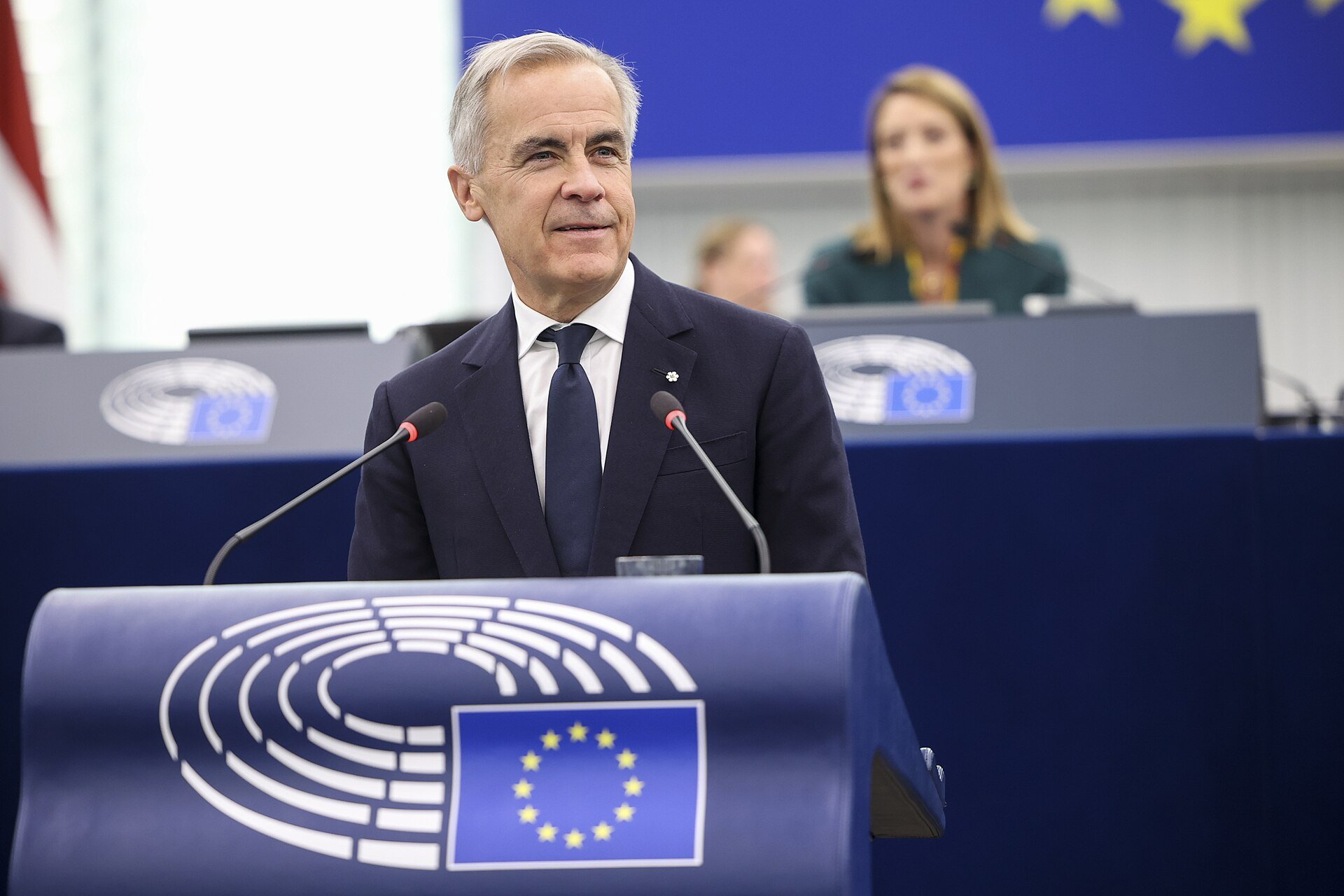
Prime Minister Mark Carney speaking to the European Parliament in September 2026. © European Union, European Parliament, 2026, via Wikimedia Commons.
Recently a friend asked whether I am hopeful about the upcoming midterm elections in the United States. “I’m hopeful but not optimistic,” I replied. I am not optimistic: whatever the election results, the political problems besetting the country of my birth are much deeper and longer lasting than one electoral cycle can solve. Yet I remain hopeful: world leaders like Canada’s Mark Carney are challenging President Trump’s authoritarian folly, and many Americans long for genuine social transformation.
Hope for the future fuels any significant political movement, whether it comes from the right, center, or left or is simply off the pollsters’ charts. We’ve seen this in the varieties of “end times fascism” that populate the Trump administration, as discussed in my previous post. Evangelical Protestants, high tech barons, and white nationalist zealots might not agree on which apocalypse they desire. But all want to seize the instruments of governmental power to unlock the catastrophic future they prefer.
What about everyone who opposes the Trumpist demolition of American constitutional democracy? Besides restraining neo-fascism and restoring a semblance of democratic representation and the rule of law, what do we hope for? It’s not hard to say what we’re against. But what are we for?
Muddy Waters
Photo by Norbert Buduczki on Unsplash.
Here the political waters get muddy and tricky shoals abound. For one thing, it’s easy to confuse longer-range social vision with either policy goals or party politics. Whether, for example, adequate health care is a universal human right often gets mixed up with debates about whether the federal government should provide Medicare for All and whether so-called democratic socialists have too little or too much sway in the Democratic Party.
For another thing, to spell out an inspiring social vision requires the sort of ethical and spiritual language that neo-fascists coopt and corrupt. The use of visionary language can also seem to disrespect cultural and religious pluralism and exclude those who don’t share the traditions from which such language arises.
Nevertheless, democratic citizens do hunger for a social vision that goes beyond party politics and policy goals, important though these are in their own right. People long to be inspired by a future worth striving for. We want to sense that the small political contributions each of us makes—discussing, organizing, protesting, donating, voting—can add up to something significant in the long run. Without this, we easily give in to a sense of futility and despair.
At the same time, we know full well that visionary language can be the honey trap of charlatans and tyrants. And we’re rightly skeptical when politicians like Donald Trump make grandiose promises they can’t possibly keep. So we’re caught between our need for visionary language and the political hazards such language brings.
Good Eschatology
Precisely because of this dilemma, however, those of us who come from religious traditions need to offer what my previous post called “a good eschatology.” Heaven knows there are many bad ones, including the hellfire and damnation of traditional Christianity and the fatalist apocalypses of end times fascism. They’re bad in both religious content and political consequences. Content wise, they reject the goodness of creation and divide humanity into the saved and the damned. Politically, they foster both a power-hungry view of government and antidemocratic exclusion.
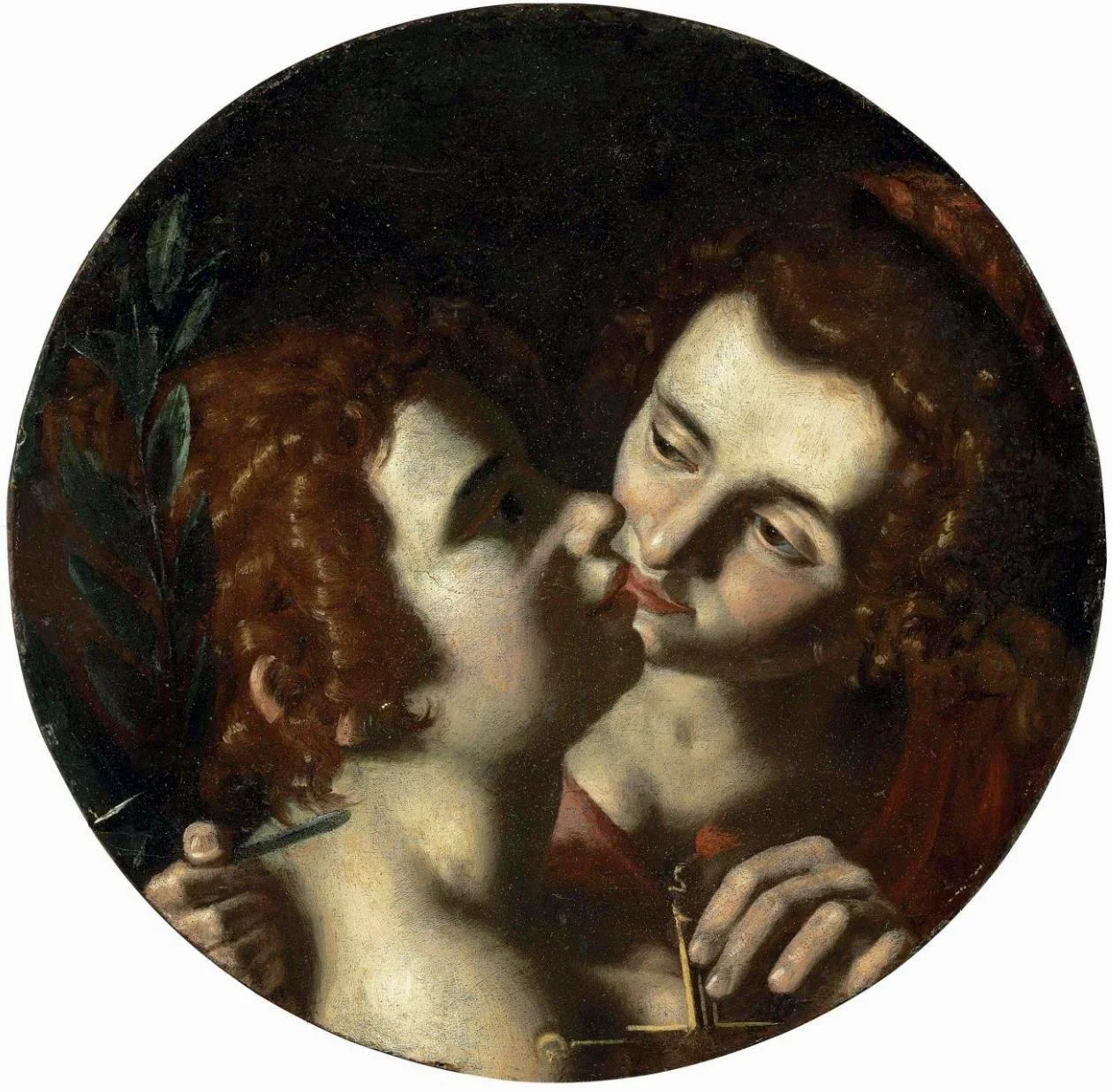
“Justice Embracing Peace” (ca. 1635). Oil painting on panel by Artemisia Gentileschi, public domain, via Wikimedia Commons.
A good eschatology, by contrast, will affirm the fundamental goodness of creation, and it will embrace the underlying unity of humanity. There are many ways to spell out these intuitions. In my own Christian tradition, as earlier blog posts on life everlasting and hope for resurrection indicate, this means envisioning a new Earth where all creatures flourish and all humans experience renewed life in its societal fullness—an Earth, in the words of Psalm 85, where truth and love converse and justice and peace embrace.*
It’s not the exclusive role of government to usher in such a future. That’s something all institutions and communities in a society need to strive for, each in its own uniquely gifted way. Yet we can hold governments accountable to this vision. Governments that promote economic inequality, persecute migrants and minorities, and destroy the environment need to be resisted and transformed toward a longed-for future in which no creature needlessly suffers.
Feast of St. Francis
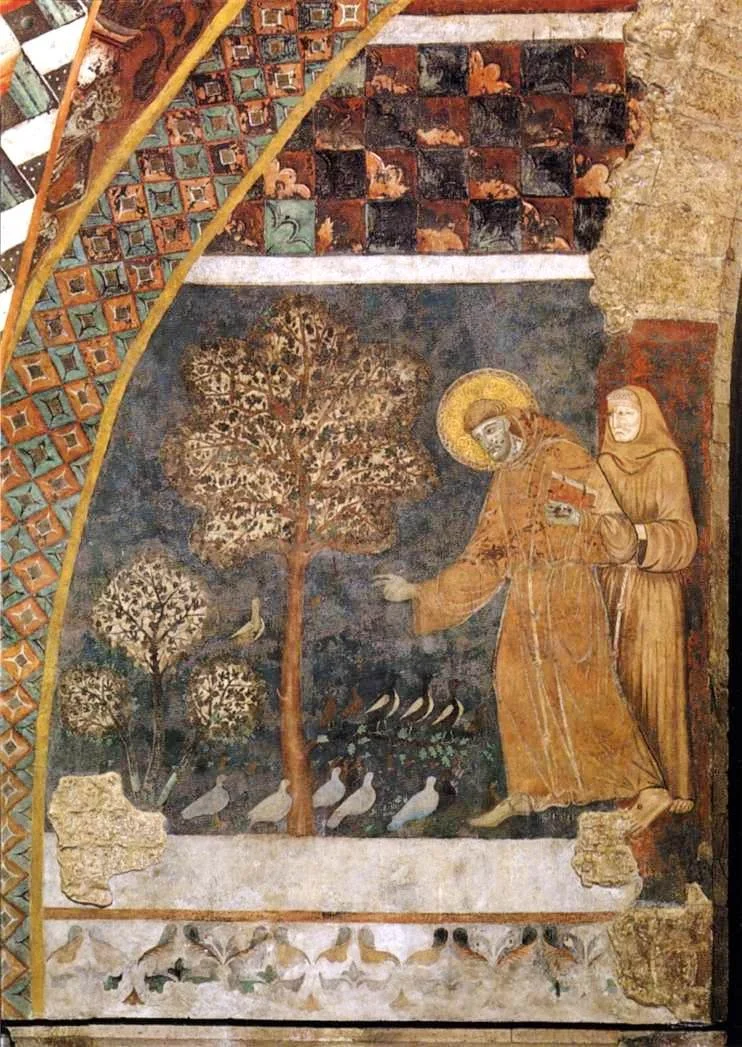
St. Francis Preaching to the Birds (ca. 1260-1280). Fresco by the Master of St. Francis, public domain, via Wikimedia Commons.
This past Sunday, October 4, churches around the world celebrated the Feast of St. Francis, the patron saint of animals and ecology. (Pope Leo XIV has also proclaimed 2026 the Year of St. Francis to commemorate the 800th anniversary of his death in 1226.) At St. James Westminster Anglican Church, where I worship and sing in the choir, the service opened with the congregation soaring through “All Creatures of Our God and King”—a setting of “Canticle of the Sun,” Francis’s most famous poem. Later the choir sang “Brother Sun, Sister Moon” by Jonathan D. Campbell, a gentle choral paraphrase of the same text.
Midway through the service we had a modified Blessing of the Animals, traditionally held on this feast day. We blessed the favorite stuffed animals the children had brought, supplemented by iPhone images of pets some adults held aloft (I displayed a photo of Ruby). Later that day there would be an actual and ecumenical Blessing of the Animals outdoors on the Wortley Village Green.
The highlight of the service was a story about Francis and the Wolf of Gubbio, which Rev. Gerry Adam told, assisted by lively animal calls from the children. Although one can read this story in Wikipedia and other sources, there’s nothing like gifted storytelling with enthusiastic audience participation.
Meeting the Wolf
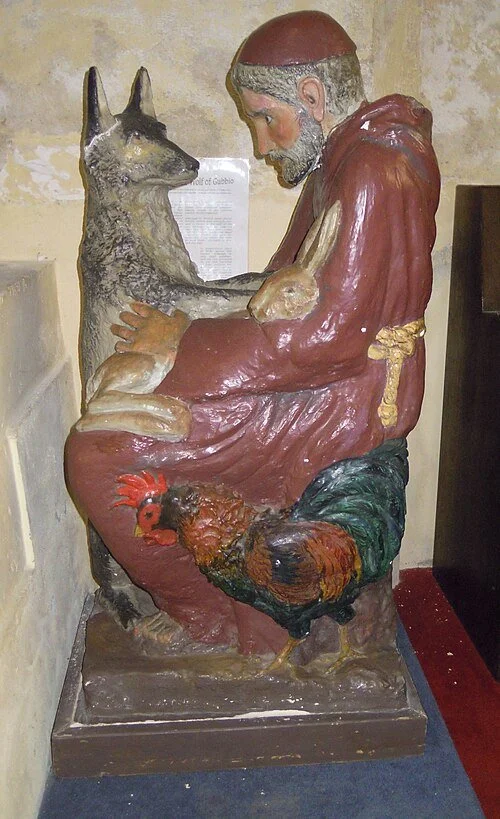
Statue of Francis of Assisi with the Wolf of Gubbio in St. Margaret’s Church, Northam, Devon. Photo by Jack1956, CC0, via Wikimedia Commons.
In brief, a lone wolf had been terrorizing the Italian town of Gubbio, where Francis lived, killing both livestock and people. Francis offered to meet the wolf. When the wolf rushed him, Francis made the sign of the cross and asked him to cease his attacks. The wolf listened, and he lay down at Francis’s feet. Then they completed a pact, with the wolf putting his forepaw into Francis’s hand to signal agreement: the wolf would stop attacking other animals and people, and the residents of Gubbio would make sure he was fed. For, Francis said, “it is hunger that has made you do so much evil.”
This story has many overtones. Let me mention two. First, there’s an eschatological echo. We’re invited to imagine a time when, in the words of Isaiah 11:6-9, “the wolf shall live with the lamb,” a time when all creatures can flourish together. Second, there’s also a redemptive resonance. We’re asked to affirm that both the perpetrators and the victims of evil can be rescued: we can remove the real sources of evil, whether unmet needs for food or an insatiable hunger for fame, and we can forge new friendships where fear has prevailed.
Listening to this story on a Sunday morning, I felt my hope renewed. Despite the howling grimness of current politics; despite the environmental, technological, and economic threats we face; despite the real, humanly created evil all around, we can still live toward a future when the wolf lies down with the lamb. I am not optimistic. But I remain hopeful.
*Footnote: I discuss Psalm 85 in my 2017 valedictory speech “Philosophy, Truth, and the Wisdom of Love.” Here are links to the YouTube video and the published text. A revised version is in my book Shattering Silos, 20-30.
Note: I notify a list of readers when a new blog post is published. If you want to join us, please let me know via the Contact button at the top of this page.