This Is So Wrong: Natural, Moral, and Societal Evil
Recently Pete Hegseth, the Trump administration’s Secretary of Defense, made a disturbing announcement about Nidal Hassan, the former Army psychiatrist who killed and wounded fellow soldiers at Fort Hood, Texas in 2009: Hassan will be executed by firing squad, and his execution will be livestreamed for public consumption.
Hearing this, I immediately thought “This is so wrong.” Both executing Hassan by firing squad and turning it into a public spectacle are so wrong. I’m not alone in thinking this. A new poll shows 80 percent of Americans oppose the livestreaming; after receiving widespread criticism from religious leaders, President Trump has called it off. Still, 53 percent approve of the firing squad execution itself. I find that equally troubling.
“So wrong” does not begin to convey how deeply repulsive I find this latest example of the Trump administration’s repeatedly trivializing human life and celebrating violent death. It’s not just wrong. We need to name it for what it is, as philosopher Susan Neiman has recently urged. It is evil.
Call It Evil
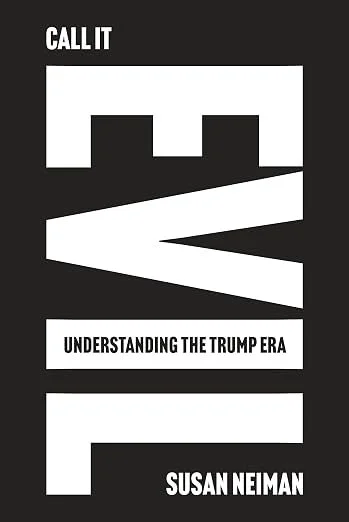
Neiman’s latest book is titled Call It Evil: Understanding the Trump Era (W.W. Norton, 2026). She argues that the ideas “Donald Trump embodies and reinforces” are “destructive enough to warrant the word evil” (2). Chief among these ideas is that everyone always and only acts out of self-interest. That’s just the way it is, supposedly, and that’s the way it should be. Consequently, Trump and his followers think moral ideas like justice and solidarity “are for suckers who don’t know they’re being conned.” It’s perfectly acceptable not to value anything “beyond the search for wealth and power. Everything else is for losers” (8).
For Neiman, the concept of evil is a central moral idea. Avoiding it out of politeness or insecurity simply undermines our social critique. Any attempt to understand and criticize the Trump administration that fails to address its underlying commitment to absolute self-interest will come up short. In effect, this commitment dismisses all moral judgment: “the signal evil of our age is the belief that self-interest is all that moves us, and ideas of justice are self-deluded hype. Evil actions are those that deny the possibility of morality” (17).
After reflecting on the concept of evil and how it gets used, Neiman challenges the assumptions of what she calls “free market fundamentalism.” She shows how the tyranny of self-interest has moved from an economists’ fiction to a powerful ideology. Then she traces how anticommunist propaganda came to dominate American politics, discusses why Israel’s war on Gaza “became the moral watershed of our time” (18), and examines how progressive identity politics has unexpectedly reinforced the ideology of self-interest. Her last chapter argues for a morally serious and non-Marxist form of socialism. In all of these ways Neiman’s book tries to challenge not just the actions and policies but the underlying ideas and commitments of the Trump era. It is well worth reading.
Types of Evil
Neiman knows that many philosophers shy away from using the term evil. So do many of her fellow travelers on the political left. For some, evil is dangerously inflammatory, too often used to fuel fires of hostility rather than shed a light of understanding. For others, the concept of evil is overly religious and of little use in secular contexts. Still others find it so vague that it not only resists definition but also supports demagoguery and demonization.
To all of these worries Neiman replies: we need ways to mark the gap between how the world is and how it ought to be. Evil, she says, is “an idea that arises whenever [this] gap … becomes too big to bear alone” (5). We need this concept to understand when things have really gone off the rails.

Photo by Norbert Buduczki on Unsplash.
I’m not sure, however, that the evil Neiman wants to identify should be called moral. Since the time of St. Augustine (354 – 430), philosophers in the West have distinguished two concepts of evil: natural evil and moral evil. Natural evil arises from natural causes and has devastating effects: hurricanes, forest fires, pandemics, and the like. It does not result from what moral agents intend or neglect to do. Moral evil arises from the actions or intentions of human agents, and it involves serious wrongdoing: murder, rape, lying, and the like. It’s something for which we hold people responsible.
Yet in recent years we’ve learned that “natural” evil often involves human agency to a significant degree. Despite climate change deniers and anti-vax rhetoric, most people recognize that human activities not only contribute to the occurrence and intensity of forest fires but also can prevent, lessen, or worsen pandemic conditions. Further, there are types of “moral” evil that go beyond the responsibility of any individual or group of individuals: what Hannah Arendt called “radical evil” (e.g., antisemitism, imperialism, and totalitarianism) and Claudia Card labels “institutional” or “structural evil” (e.g., terrorism, torture, and genocide).
The destructive trends both embodied and promoted by the Trump administration are deeply embedded in social institutions and societal structures. Fascism, militarism, racism, and misogyny are not simply moral evils. Although they may draw on the anti-moral ideas that Neiman singles out, these trends are more intractable and complex than moral failures. For they attack the societal basis of what I call “interconnected flourishing.”
Wolf Revisited
That’s why, in my own writings, I’ve introduced the idea of societal evil. As my blog post Slow Train Coming indicates, this refers to evil that becomes embedded in our cultural practices and social institutions and, gathering strength, comes to dominate an entire society. Because it’s so pervasive, societal evil is hard to recognize—it’s like the polluted air we breathe. And because it’s so deeply entrenched, it is also hard to resist. (For elaborations, see my books Religion, Truth, and Social Transformation, 233-34, 319-23; Shattering Silos, 26-27, 98-100, 175-77; and Social Domains of Truth, 291-96.)

Francis Instructing the Wolf (1911). Engraving by Carl Weidemeyer-Worpswede in Die Blümlein des heiligen Franziskus von Assisi, public domain, via Wikimedia Commons.
My most recent post on the U.S. midterm elections told about St. Francis’s meeting the wolf of Gubbio and addressing the deep hunger that drove the wolf’s evildoing. Soon after posting this, I received a substantial email from my former student Dean Dettloff. Dean is a research and advocacy officer at Development and Peace – Caritas Canada, a development agency rooted in Catholic social teaching that pursues global solidarity. He’s keenly aware of issues pertaining to ecological justice and democratic participation.
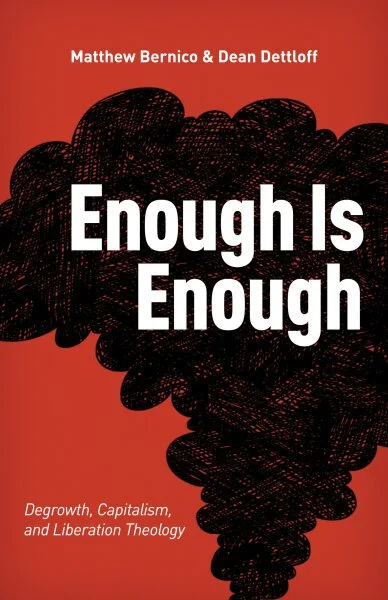
Reinterpreting the story of St. Francis, Dean sees inhabitants of the Global North as the wolf whose hunger has made us do evil. We are driven by our “consumptive appetites” and capitalism’s unavoidable profit motive toward the re-militarization, anti-immigrant stances, and reversal of environmental progress that now characterize national policies in the United States and Canada. Perhaps the groundswell of activist opposition in global civil society can stand in for a pacifying St. Francis. Dean details these matters in his new book, co-authored with Matthew Bernico, titled Enough Is Enough: Degrowth, Capitalism, and Liberation Theology (Fortress Press, 2026). (There will be an online discussion and book launch this Friday, October 23; here’s the link to that.)
What Dean recognizes, and what his new book demonstrates, is that the ongoing destruction of Earth’s biosphere is not simply a moral evil. It is that, of course, and Dean rightly points to our collective responsibility for having created it and needing to address it. But it is also so pervasive and so deeply entrenched in the way our political and economic systems operate that it exceeds what any one of us or any group or country can shoulder. Climate change points to societal evil.
Conceptual Tension

Photo by Shane Rounce on Unsplash.
There’s a tension, however, built into the concept of societal evil, one I need to address. On the one hand, by locating evil in the very fabric of society, the concept of societal evil appears to absolve all of us from responsibility for its existence and its removal. Such evil seems like a fate rather than a foe, something we must live with rather than resist.
On the other hand, by calling certain society-wide tendencies “evil,” we seem to make all members of a society equally complicit in evil’s existence—as if, for example, there’s no difference in accountability between someone who rejects racism and someone who embraces it or between politicians who promote environmental destruction and those who would lessen or reverse it. In this sense, the concept of societal evil seems to undermine the prospects for what Neiman calls “moral judgment,” precisely what she says the Trumpian tyranny of self-interest does.
So there’s a tension between the scope of the concept—it applies to society-wide tendencies—and its meaning—it pertains to the sorts of harms for which we normally hold actual people responsible. The concept of societal evil simultaneously seems to make no one and everyone responsible for widespread injustice, social hostility, and environmental degradation. I’ll try to sort out that tension in a subsequent post.
In the meantime, I hope no one strongly repulsed by a proposal like livestreaming a firing squad execution hesitates to call it evil. I also encourage us to consider whether it’s simply a moral evil. Or might it also bring societal evil to the surface?
Note: I notify a list of readers when a new blog post is published. If you want to join us, please let me know via the Contact button at the top of this page.