Apocalypse Now: Facing Fatalist Fascism
Three months ago I described eschatology as “the hidden minefield of American politics today.” I suggested that traditional Christian teachings about “the last things” feed into white Evangelical Protestant’s support for Donald Trump. That’s especially so of the notion that some people are eternally dammed to hell and others—the saved—are destined for heaven. I titled this blog post What the Hell? Eschatology Reconsidered.
I’d like to pick up where that post left off. I want to ask whether bad eschatology is the key to contemporary fascism.
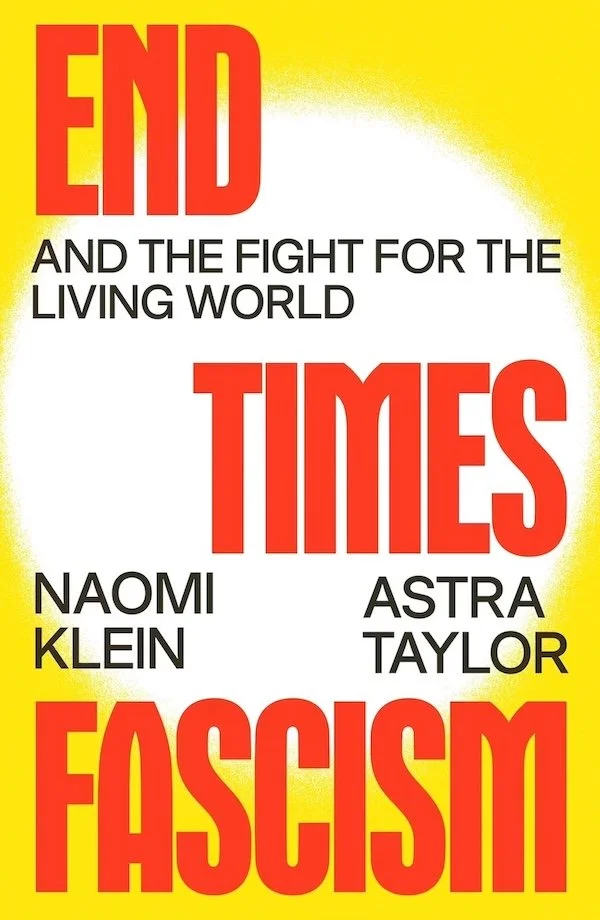
My question arises in part from the publication of a new book by Naomi Klein and Astra Taylor titled End Times Fascism: And the Fight for a Living World (Farrar, Straus & Giroux, 2026), which was released on September 15. Book reviews have already appeared in the New York Times and the Guardian. Amy Goodman and Juan González have hosted an especially illuminating interview with the two authors on the news program Democracy Now!
According to Klein and Taylor, three strands of contemporary fascism that share an apocalyptic vision intertwine in the Trump administration. All three look forward to a coming cataclysm. It will destroy much of humanity and the Earth. But it will create a better future for themselves and for people like them. These fascists do not fear the apocalypse. They welcome it, and they do what they can to bring it on. They are end times fascists, enraptured, in my own terms, by bad eschatology.
Fascist End Timers
The three strands Klein and Taylor identify are religious, techno-economic, and political. First, and perhaps most readily recognizable, are the “religious end timers.” They include both white Evangelical Protestants and messianic Israeli Zionists. Evangelicals in particular tend to welcome each new disaster, whether environmental or geopolitical, as signs that the end of the world is near. These are signs, they say, that Jesus will return soon to rescue his followers and send everyone else to hell.
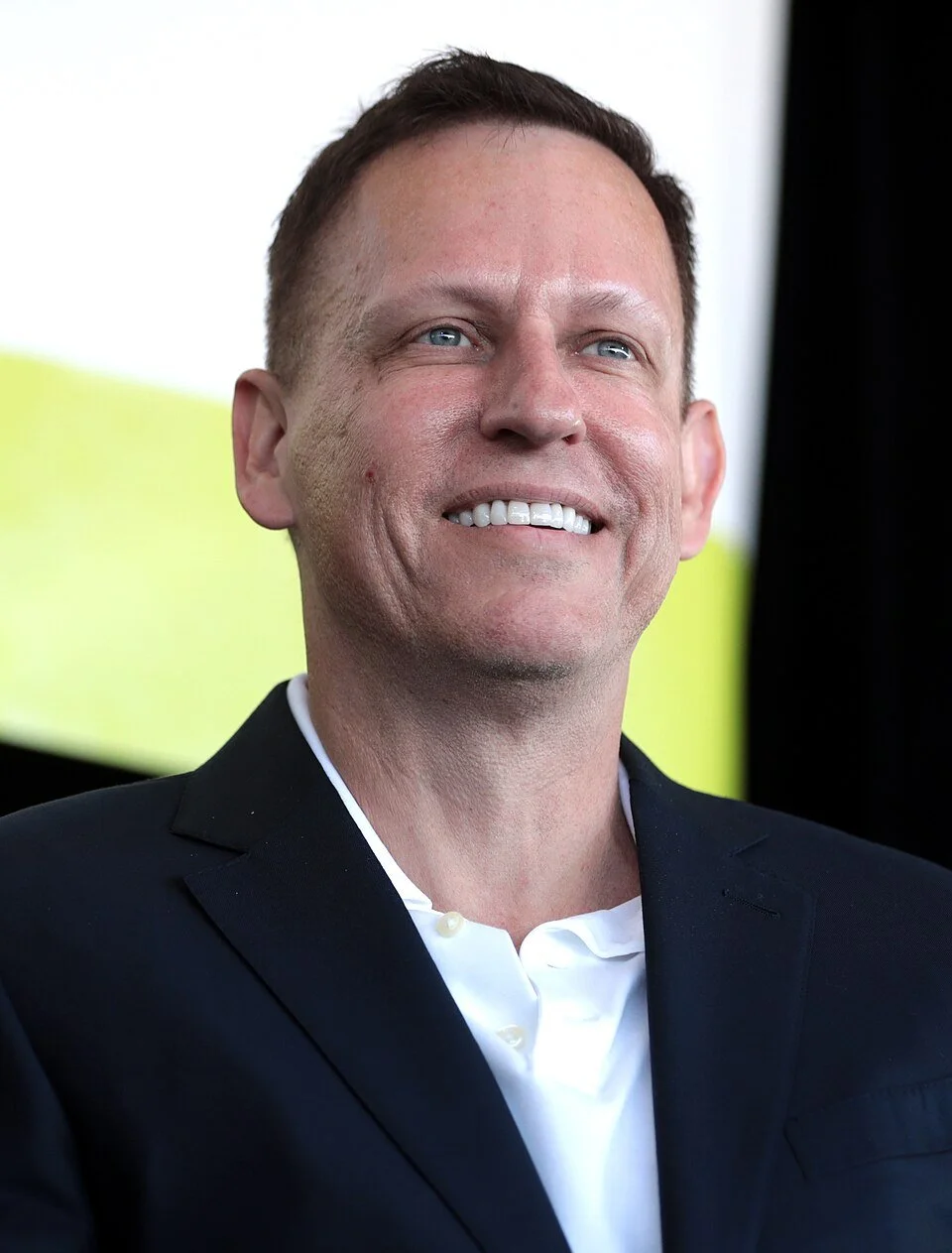
Peter Thiel in 2022. Photo by Gage Skidmore, CC BY-SA 3.0, via Wikimedia Commons
The second strand consists of “tech end timers.” They worship the gods of hyper-wealth and high-tech power. New tech barons such as Peter Thiel and Elon Musk believe only digital advances, spearheaded by an AI arms race, can save humanity. As their recent debates about regulating and slowing AI development show, apocalyptic tech bros recognize that the new digital frenzy makes exorbitant demands on the environment and potentially threatens millions of lives and jobs. Yet they imagine they themselves will be spared, indeed, that they will flourish in their gated communities and interplanetary travels. If most others don’t survive, that’s their problem.
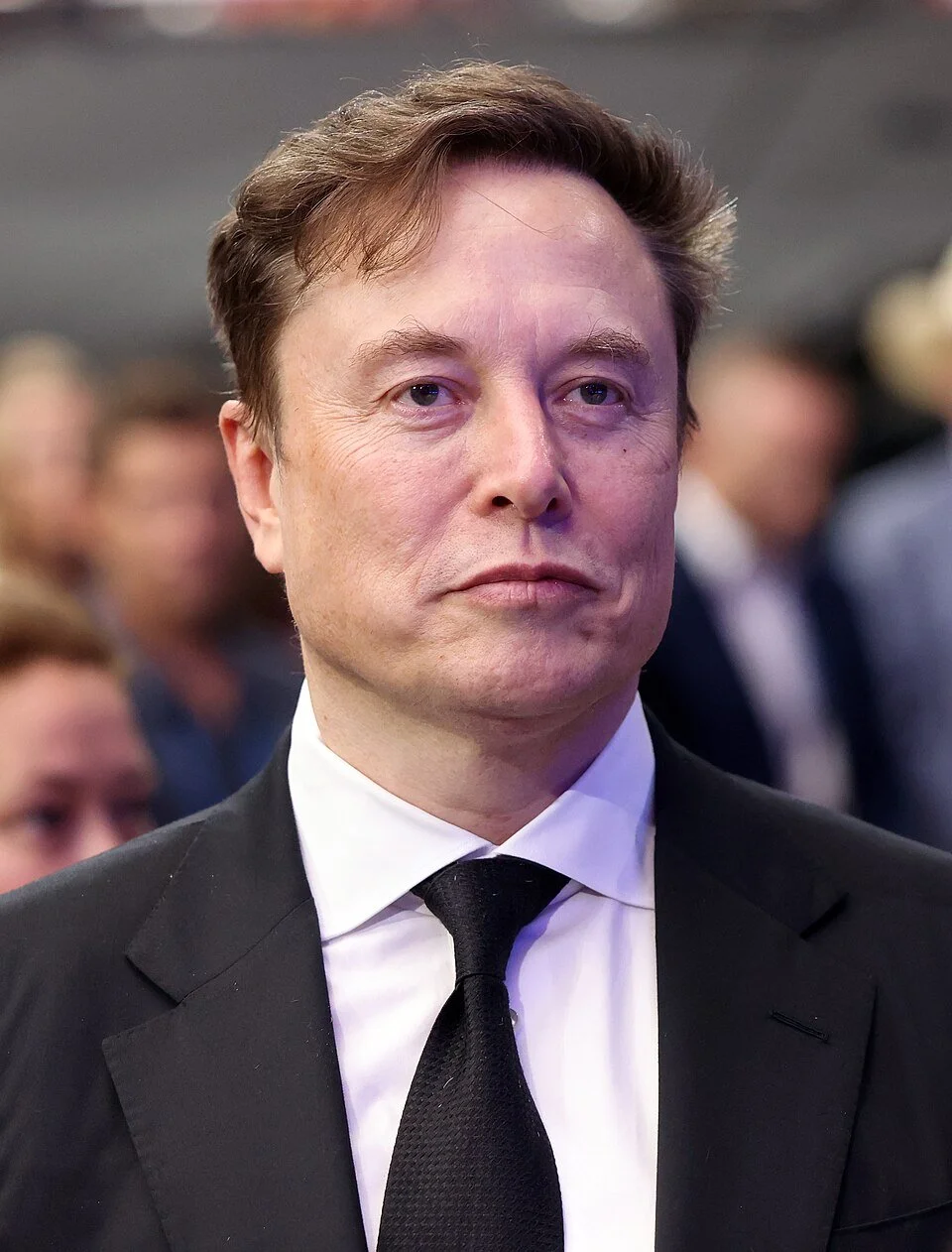
Elon Musk in 2025. Photo by Gage Skidmore, CC BY-SA 4.0, via Wikimedia Commons
“Ethno-nationalist end timers” make up the third faction of fascism in the United States and beyond. As poverty, climate change, and civil strife propel waves of refugees toward wealthier nations, white nationalists and the like try to turn their countries into bunkered garrisons and drive the “foreigners” away. They do not wish to address the ills that compel people to migrate. Rather, ethno-nationalist end timers actively undermine the international agencies and regulations already in place and try to secure their own people’s salvation.
Clearly tensions exist among these three apocalyptic factions. They do not share the same vision of how the final catastrophe will happen, who will be saved, and who is unworthy of salvation. Yet, as they seize the reins of government and ride it to their own advantage, they’re united in their attachment to bad eschatology.
Recurring Tendency
What, you may ask, makes any of these fascists? Klein and Taylor see fascism as a recurring tendency that arises among society’s elite in response to failures in the capitalist economy that threaten their own positions. Fascism harnesses the economic and cultural despair of less privileged classes. It directs their anger and frustration toward people who are even more vulnerable rather than at the economic system and its privileged overlords. This describes both European fascism in the early to mid-twentieth century and the resurgence of fascism today. What distinguishes resurgent fascism, however, is its apocalyptic vision.
Although helpful, this description doesn’t uncover the primary dynamics of political fascism. Perhaps that’s why, in a frustrating interview with Klein and Taylor in the New York Times, David Marchese keeps coming back (unhelpfully, I might add) to the question of how to define fascism. Let’s see whether I can fill the apparent gap.
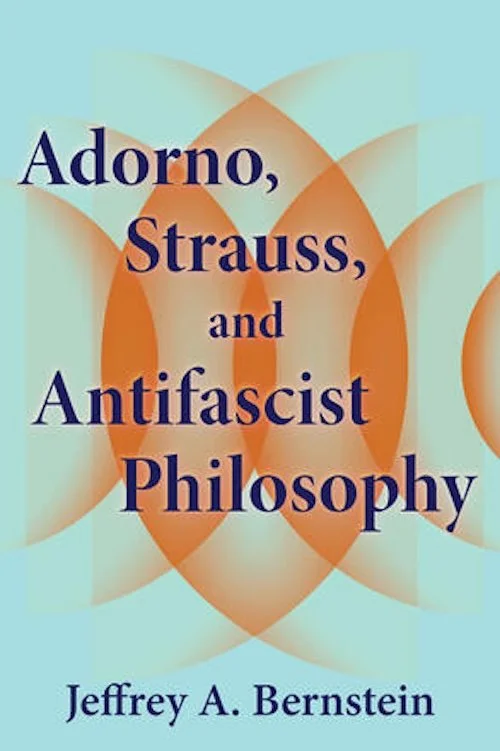
Recently I wrote a book review of a slender volume by Jeffrey A. Bernstein titled Adorno, Strauss, and Antifascist Philosophy (SUNY Press, 2026). Theodor Adorno (1903-1969) and Leo Strauss (1899-1973)—Jewish intellectuals who fled Nazi Germany in the 1930s and settled in the United States—represent opposite sides of the political spectrum: Adorno as a radical critic of capitalism whose astute diagnoses of right-wing politics continue to inspire intellectuals and activists on the political left; Strauss as a conservative critic of modernity whose challenges to liberalism energize intellectuals and activists on the political right. Yet Bernstein argues they had complementary views about fascism that can help us address its resurgence today.
To set up this argument, Bernstein gives a helpful description of what fascism comes to: it is a mass political movement that is reactionary, anti-liberal, nationalistic, authoritarian, and complexly related to both populism and capitalism. Let me summarize his description.
Features of Fascism
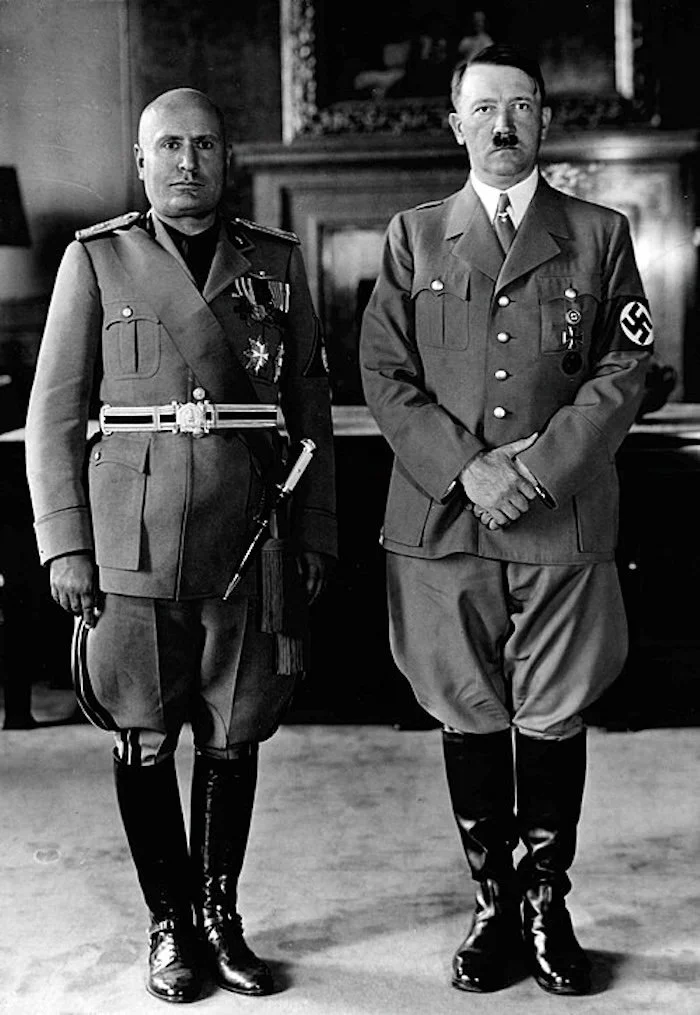
Benito Mussolini and Adolf Hitler during Mussolini's visit in Munich, June 19, 1940. Unidentified photographer, Public domain, via Wikimedia Commons.
First, as a mass movement, fascism exhibits a tight connection between a lionized leader—e.g., Hitler or Trump—and “susceptible masses of people” (9)—e.g., German Nazis or the American MAGA crowd. Fascism is anti-liberal in the sense that it both rejects liberal or socialist policies and ultimately opposes the Enlightenment values of liberty and equality. It is also reactionary: it wishes either to undo the patterns of modern life [e.g., white nationalist opposition to DEI (diversity, equity, and inclusion)] or rapidly leave them behind (e.g., the tech bros’ futurism).
Fascism is also nationalistic. It aims to replace the pluralist state, where many different religions, ethnicities, races, and linguistic communities have equal standing, with one preferred nation or people (e.g., white Americans).
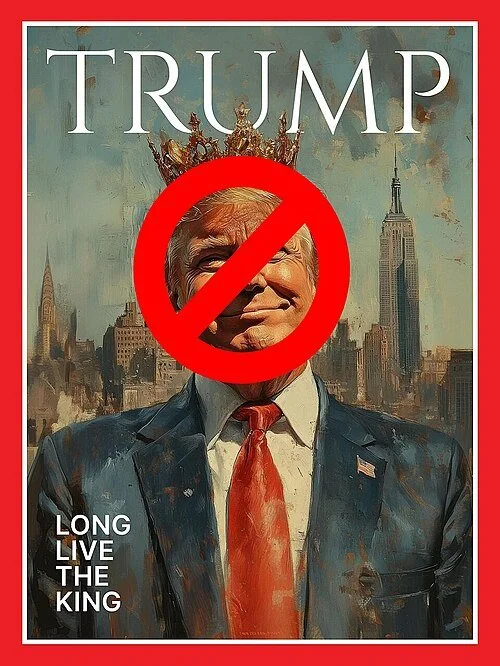
The image of “King” Donald Trump adapted for anti-Trumpists and anti-fascists in general. Image by DannyRogers800, CC0, via Wikimedia Commons.
The lionized leader represents the unity of the state and the preferred nation; the government he leads is no longer truly of, by, and for all the people but only some. This leader is typically what Bernstein calls a “maximalist leader.” He (and it’s always a “strongman”) both “seeks to consolidate power beyond the scope of that furnished by liberal democracies” and makes “maximal appeal to the sprawling passions of his followers” (17). Both Hitler and Trump fit this description. They are authoritarian leaders.
Then there are fascism’s complex connections to both populism and capitalism. While fascism definitely is a populist movement, only part of a country’s population count as “the people.” That’s why “scapegoating other groups,” such as immigrants or sexual minorities or “woke” intellectuals, is “an inevitable part of … fascism” (20). Similarly, fascism has a complicated relation with capitalism. On the one hand, it arises as a reaction to the worst tendencies of capitalism. On the other hand, it serves to secure power structures that are of greatest advantage to the captains of capitalism. Paul Krugman’s posts this past summer about an American oligarchy bear eloquent witness to the latter.
Futural Vision
From these descriptions we can see why political fascism and political democracy do not mix. That’s why contemporary fascists are doing their utmost to weaken, subvert, and destroy the institutions and norms of democratic governance in the United States and in other countries. That in itself makes the resurgence of fascism most troubling.

Point Reyes National Seashore. Photo by Casey Horner on Unsplash.
What makes it overwhelmingly dangerous, however, is the apocalyptic vision of end times fascism. It’s not just that present-day fascists don’t care about democracy. Deep down they don’t care about human wellbeing and the good of our planet, as Klein and Taylor show. They are fundamentally fatalistic.
To resist resurgent fascism will require more than strategic organizing and electoral politics, crucial though these are. We need to forge a life-giving and life-sustaining vision for the future, one where no one is excluded and all creatures can flourish. As I’ll explain in a subsequent post, we need to offer a good eschatology.
Note: I notify a list of readers when a new blog post is published. If you’re not on that list and wish to join us, please let me know via the Contact button at the top of this page