Life, Death, and Life beyond Death
Religious Reticence
Regular readers of this blog know that I rarely discuss explicitly theological topics or present worked-out stances on religious teachings. I might touch on such topics, and I might implicitly appeal to certain religious notions. Yet I rarely go into details or lay out an explicit position. This, despite the fact that my philosophy has roots in a religious tradition. And, as was mentioned in my remembrance of Jürgen Habermas, my next book will likely be on the role of the world’s religions in developing an Earth-sustaining and life-giving global ethic.
There are two reasons for such theological modesty and religious reserve. First, I’m not trained in theology in the way I’ve studied philosophy, and I don’t wish to pretend to an expertise I actually lack. Second, I try to write inclusively for an educated audience. I don’t want to exclude readers whose religious traditions or spiritual orientations differ from my own.
Death and Dying
Nevertheless, certain topics do require more theological and religious candor. One came up in my previous post about A German Requiem by Johannes Brahms. There I mentioned a creedal document from my own religious upbringing—the Heidelberg Catechism—and discussed whether Brahms’s requiem presents a universalist or a specifically German Lutheran stance toward death. But I didn’t say how I view these matters.
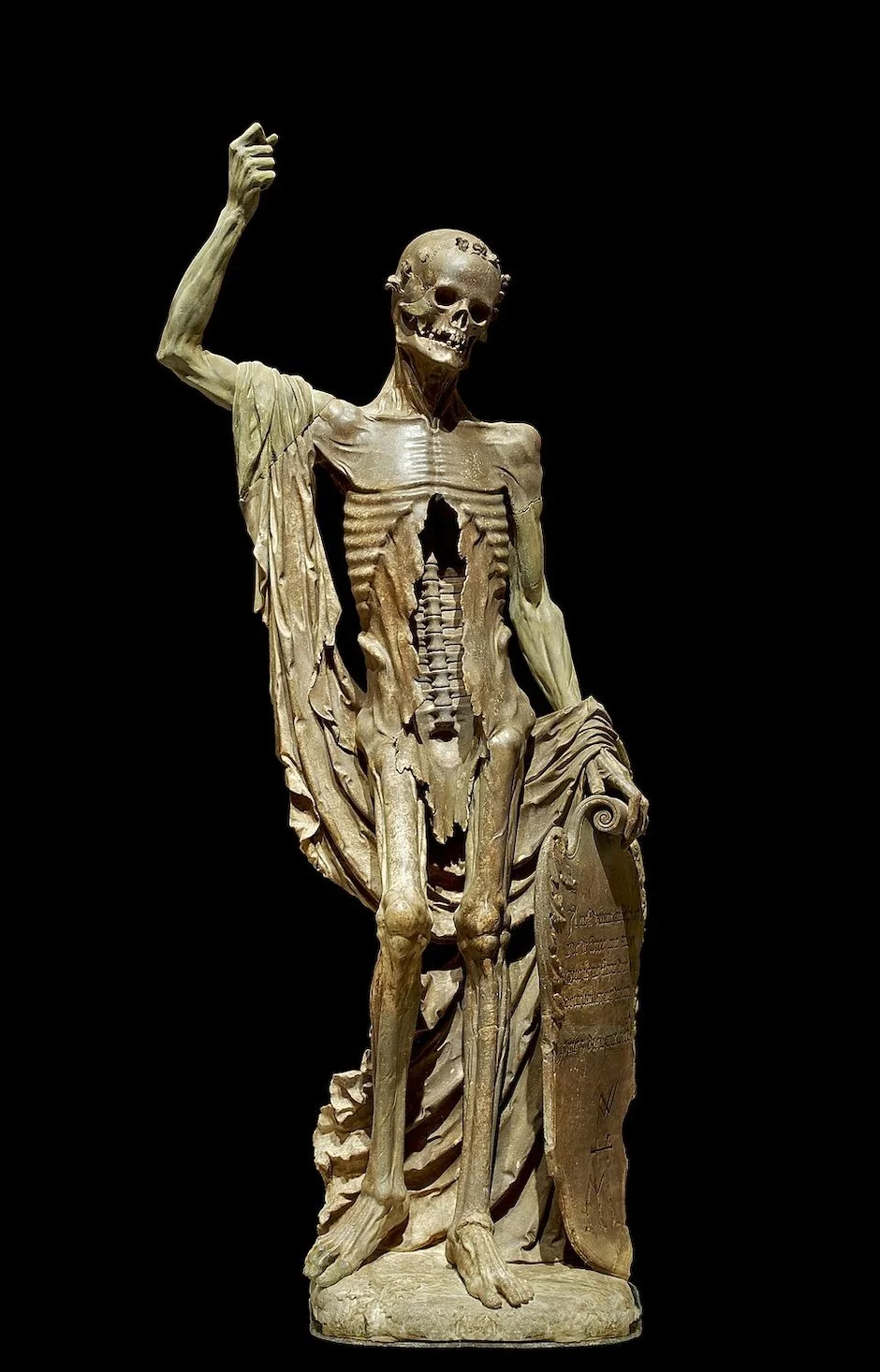
"The Death of Saint Innocent" (1520/1530). Alabaster statue from the Cemetery of the Innocents in Paris, France. Image via Wikimedia Commons.
Like many of you, I’m now old enough to be facing my own death, even as I regularly say goodbye to mentors, colleagues, and friends who have died. If you’ve grown up in a monotheistic religious tradition, it’s pretty hard not to wonder what it means to die and whether there’s life after death. And when we talk about our own deaths, it’s difficult to avoid taking theological stances and either embracing or rejecting religious traditions.
Moreover, the farther one delves into this topic, the more obvious it becomes that views about death are also views about living. That’s particularly so with regard to one notion that, perhaps more than any other, has steered Christianity in the wrong direction. I’m talking about the idea that human beings either have or are immortal souls. It’s an idea that has little basis in the Bible, and it severely distorts how people understand life, death, and life beyond death.
Immortal Souls?
When I was growing up, children in Christian families across North America often prayed:
Now I lay me down to sleep,
I pray the Lord my Soul to keep;
If I should die before I 'wake,
I pray the Lord my Soul to take.
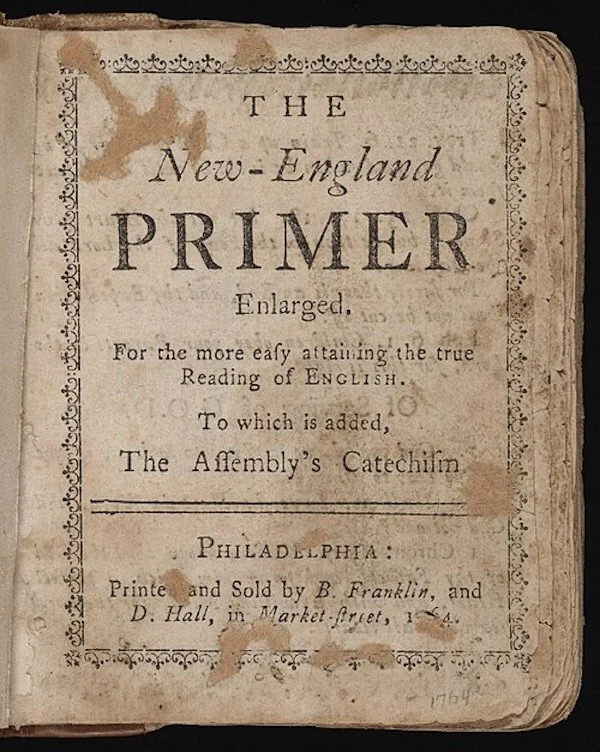
Frontispiece from The New England Primer, enlarged (1764). via Wikimedia Commons
Apparently this simple prayer comes from The New England Primer, a reading primer from colonial America that was the leading educational textbook in the latter seventeenth century and grounded most schooling until the 1790s. So it has been prayed for hundreds of years. By reciting it every night, devoutly kneeling beside our beds, we children drank in metaphysical immortalism like our mothers’ milk.
Let me explain. The prayer singles out the soul—not the body—as the crux of human life. What we really care about is that the Lord takes care of our souls while we sleep. The prayer also suggests that the soul is imperishable, is separate or separable from the body, and goes straight to heaven when we die. That’s why we ask the Lord to take our souls if we should die. It’s not clear from this prayer whether we should also expect a “resurrection of the body,” as the Apostles’ Creed puts it. By not mentioning this, however, the prayer communicates that our imperishable souls matter most.

Photo by Lutz Stallknecht on Unsplash
In other words, our innocent childhood prayer revolved around the notion of an immortal soul. It assumes that we have a permanent immaterial soul-substance, somehow separable from the material body, that outlasts us in death. This notion is deeply embedded in the Christian tradition. Yet it does not stem from the Bible Christians hold dear. Rather, it stems from Greek philosophy, especially the metaphysics of Plato and its modification by Aristotle. That’s why I call this view metaphysical immortalism.
I believe metaphysical immortalism wreaks havoc with our views of both life and death. To show why, I need to talk about biblical anthropology. In a later post I’ll offer a philosophical alternative.
Biblical Anthropology
Biblical scholars—i.e., scholars who study the history, context, language, texts, and meaning of the Bible—have known for years that the canonical Hebrew scriptures contain no notion of an immortal soul. The key Hebrew terms in these writings, transliterated and given rough English equivalents, are nephesh (“soul”), ruach (“spirit”), and leb (“heart”). None of these terms indicates a permanent, immaterial, and separable substance that outlasts us in death.

Käthe Kollwitz, “Brustbild einer Arbeiterfrau mit Blauem Tuch” (Working Woman in a Blue Shawl), tri-colored lithograph, 1903.
Although the three terms have variegated usages, there’s a common thread: each term indicates the whole human being in relationship to God, others, and creation. Roughly, nephesh (“soul”) points to human life as a whole in its vulnerability and need for deliverance (“As a deer longs for flowing streams, so my nephesh longs for you, O God,” Ps. 42:1). Ruach (“spirit”) refers to the animating force that sustains us (“Answer me quickly, O LORD; my ruach fails, Ps. 143:7). And leb (“heart”) picks out the whole-life-orientation of human beings [out of the heart “flow the springs (or issues) of life,” Prov. 4:23].
Also, there’s no firm distinction and certainly no separation between “body” and “soul” or “spirit” in the Hebrew scriptures. They have a holistic understanding of what it means to be human. And that carries over into their understanding of what it means to die.
Biblical scholarship on the Greek New Testament is more mixed. While some scholars detect influence from Greek thought, others see continuity with the Hebrew scriptures. Without claiming expertise in these matters, I rely on the work of biblical scholars who argue that the crucial New Testament terms also need to be taken holistically, rather than as terms for discrete parts or substances or components of the human being. For that’s how the New Testament writers used and understood them in their context.
The Greek terms that parallel Old Testament terminology, with their Hebrew counterparts and English approximations, are psyche (nephesh, “soul”), pneuma (ruach, “spirit”), and kardia (leb, “heart”). Also important, given the issues of dichotomy and trichotomy to be discussed in a later post, are the terms soma (body) and sarx (flesh).
Years ago the Dutch theologian Herman Ridderbos argued for a holistic understanding of these terms in the writings attributed to the Apostle Paul [see Ridderbos’s book Paul: An Outline of His Theology (Eerdmans, 1975), 115-121]. Soma (body) refers to the entire human being in his or her “temporal bodily existence.” It does not designate a distinct or separate part or substance. Kardia (heart) indicates how, in the entirety of our existence, we are motivated from “within,” from the center of who we are. Pneuma (spirit) indicates how this “inner self” bursts out in concrete activities and deeds; it gives “no trace of the spirit as a [supposedly] supersensual divine principle inherent in [human beings]” (with specific reference to 2 Cor. 2:13 and 7:5). Psyche (soul) stands for our “earthly life, which has no subsistence in itself but is subject to death and destruction” (with specific reference to 1 Cor. 15:44ff.)
In other words, Paul’s writings neither employ nor endorse the notion of an immortal soul. And neither do the other writings in the New Testament.
Severe Distortions
In fact, the tendency to read this metaphysical notion of immortality into the New Testament severely distorts Christian teachings and practices. It undermines the Bible’s proclamation that God created everything good; that the fall into sin and evil permeates all of human life; and that everything—indeed the entire universe—is redeemable and redeemed (Col. 1:15-20).

Photo by Tiago Ferreira on Unsplash
It’s not hard to see why this is so. First, the notion of an immortal soul creates or presupposes a hierarchy between that which is perishable and that which supposedly is not. This leads people to regard the imperishable (soul) as better or more important and the perishable (body) as less good or even evil. Second, immortalism helps create a distorted, individualistic, and moralizing picture of sin and evil such that, for example, sexual immorality is terrible but social injustice isn’t really a problem.
Third and correlatively, immortalism limits the scope of redemption to the salvation of souls. Consequently it downplays the reality of suffering and the grief we face when loved ones die. And it turns the hope for a new creation into misplaced longing for a disembodied eternity in heaven. In all of these ways, it’s contrary to what I believe the Bible actually proclaims.
Because metaphysical immortalism stems from ancient Greek philosophy, biblical scholarship does not suffice to challenge it. We need an alternative philosophical anthropology, one that does not divide human existence into two or three parts (e.g., body, soul, and spirit) and does not privilege one part over others. I plan to sketch this alternative in my next blog post. There I’ll argue that we do not have immortal souls. Nor, for that matter, do we have bodies.
Life Everlasting
For now, let me make some remarks on “eternal life,” an idea Christians usually pair with the notion of an immortal soul. My objections to metaphysical immortalism oblige me to give a different account of eternal life. For “eternal life” cannot mean the timeless and uninterrupted existence of an immortal soul.

Photo by Jeffrey Workman on Unsplash
That’s why I prefer to talk about “everlasting life” rather than “eternal life.” Apparently we can use the two terms interchangeably to translate many key passages in the Bible. But “everlasting” has the advantage of suggesting something that begins in time and continues. “Eternal,” by contrast, suggests something timeless—a feature that traditional Christian theology, when it’s careful, reserves for God and does not assign to anything created, not even human beings.
If “everlasting life” does not signify the timeless existence of immortal souls, then what does it mean in the New Testament? Again, as with terms like psyche, pneuma, and kardia, there are variegated usages; no one definition suits all usages. There seems to be a major difference, for example, between the synoptic gospels, where “everlasting life” suggests a future condition, and the Gospel of John, where it suggests something that begins in the present.
But these aren’t insurmountable differences, given how Jesus and the gospel writers talk about the “kingdom of God” as both present and future. And the idea of the kingdom of God—or God’s reign—is the key to what “everlasting life” means. Everlasting life is life in its fullness within the Kingdom of God. It is life in the condition that the Hebrew scriptures envisioned as “shalom”—a condition I’ve described as interconnected flourishing. It is life restored to right relations with God, self, others, and all creation.
This is not an otherworldly life. It is life in which all needs are met, loved ones are embraced, and justice prevails. It’s life lived in love for God, self, and neighbor within the concrete details of daily experience. The gospel writers say Jesus ushers in such life, and he promises it in abundance for those who follow his ways.
Although a substantial theological account of “everlasting life” is beyond my competence, I do recommend J. Richard Middleton’s book A New Heaven and a New Earth: Reclaiming Biblical Eschatology (Baker Academic, 2014). There, in the words of the publisher’s blurb, Middleton shows that “the ultimate blessed hope for the believer is not an otherworldly heaven; instead, it is full-bodied participation in a new heaven and a new earth brought into fullness through the coming of God's kingdom.”
Such full-bodied participation, beginning even now, is what I think the New Testament means by “everlasting life.” And for those of us who expect a “resurrection of the body,” that’s what life after death will be like. Now, perhaps, we can finally put the immortalist prayer of our youth to sleep. May it rest in peace.
Note: I notify a list of readers when a new blog post is published. If you’re not on that list and wish to join us, please let me know via the Contact button at the top of this page.