Ideologies of Warfare: Identity, Wealth, and Might

“No Kings” protest, Lawrence, Kansas, March 28, 2026. Photo by Catboy69, via Wikimedia Commons
A month has passed since the United States and Israel launched the massive air attacks discussed in my post America’s War on Iran. As expected, this unjustifiable and illegitimate war has met none of its ever-changing goals. And last weekend’s energetic “No King’s” protests across the United States show it will never receive significant popular support.
Also as expected, most debates about the war focus on motivations and consequences, with occasional side glances to questions of principle. Politicians and commentators are asking why the Trump administration not only launched this battle but also seems poised to send in ground troops, turning it into the sort of “forever war” Trump’s electoral campaign rejected.
They also debate whether the consequences are acceptable: indiscriminate destruction of life; ever-widening zones of international conflict; severe disruption of global trade; the more-than-trillion-dollar American military expenditures to date—not to mention the upward spiral in prices for gas and groceries. Some pundits wonder whether, in principle, there’s any sense in which this can be considered a just war. And today Chuck Hagel and Leon Panetta, two former secretaries of defense, warned about the rapidly unfolding disaster that results from “a president acting alone without a strategy and … a politically divided Congress that has abdicated its responsibilities and failed to play its vital constitutional role of oversight in war.”
All of these issues are worth raising. Yet they can become noisy distractions. As my previous post suggested, we need to listen past the noise. So, beyond asking about motivations, consequences, and principles, I’d like to consider two other ways to evaluate the decision to wage war on Iran. These ways are ideological and directional.
Three Ideologies
In February my blog post Slow Train Coming introduced Bob Goudzwaard’s diagnosis of the ideologies that drive contemporary capitalist society. He says they rely on a deeply spiritual faith in humanly achievable progress. This faith turns the economic, technological, and scientific tools of progress into idols.
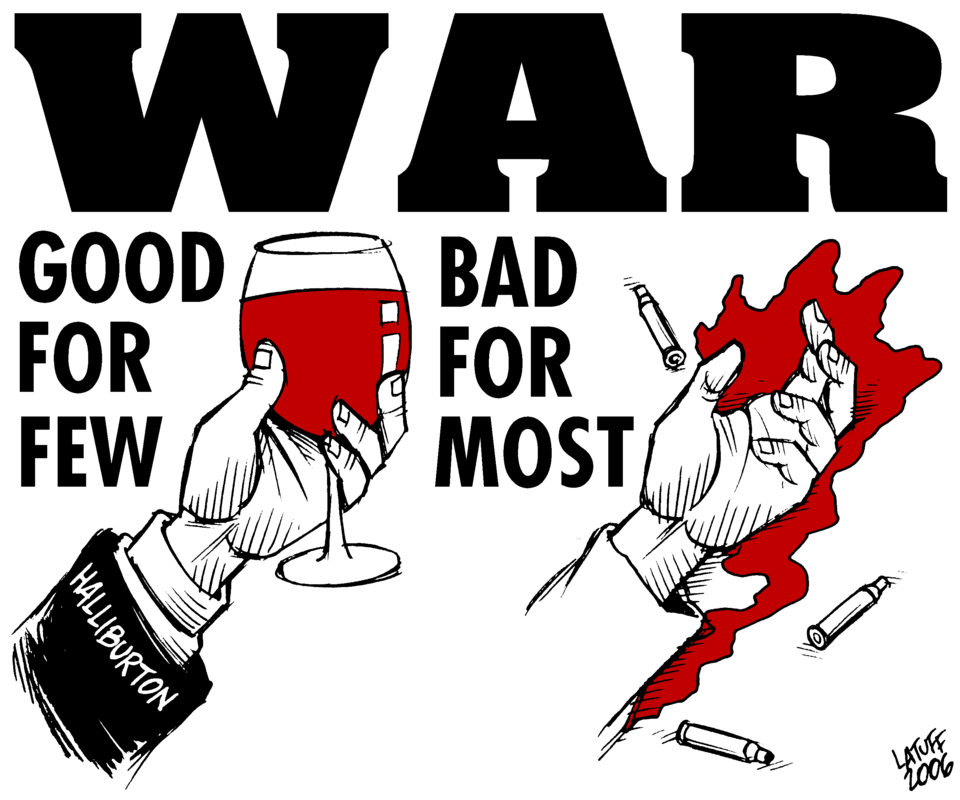
Image by Carlos Latuff via Wikimedia Commons
Three ideologies in particular shed light on the new Iran war. To borrow from chapter titles in Hope in Troubled Times (Baker Academic, 2007), which Goudzwaard co-authored, they are the ideologies of “Identity Unleashed,” “Prosperity Unshackled,” and “Guaranteed Security.” Less literary labels would be: group identitarianism, economic materialism, and high-tech militarism.
These are huge topics, of course; a single blog post can’t do them justice. Yet I want to say enough to show how they combine to drive countries into catastrophic conflicts that hardly anyone wants and from which nearly everyone suffers. I’ll discuss them in the order listed, which mirrors the sequence of chapters 4-6 in the book by Goudzwaard et al.
Group Identitarianism

Lambda, a symbol of the Identitarian movement in Europe. Image by Blackcat via Wikimedia Commons.
The term identitarianism usually refers to the right-wing Identitarian movement in Europe, whose counterparts include white Christian nationalism in the United States and Canada. Identitarianism claims that multiculturalism, immigration, and economic globalization threaten the ethnic and cultural identity of white Europeans. The movement aims to preserve this identity by getting rid of nonEuropean migrants and celebrating ethnic European cultures, with a policy called ethnopluralism. The movement regards Muslim immigration and the spread of Islam as the greatest threats to white European identity.
I use the term group identitarianism more broadly, however, to refer to any ideology that sacralizes a group identity—whether cultural, ethnic, national, or religious—and demonizes groups perceived to threaten this identity. Radical Islamism and militant Zionism fit this description. So does white Christian nationalism in North America.
For many of President Trump’s supporters, MAGA means “make America patriarchal, White, and Christian again,” at the expense of all groups who supposedly undermine this identity—most obviously, recent nonWhite immigrants and refugees, but also Blacks, Latinos, feminists, members of the LGBTQ+ community, and anyone else who resists MAGA’s reactionary agenda. Latent antisemitism and blatant Islamophobia easily comport with this identitarian ideology, since Jews and Muslims can be regarded as threats to the supremacy of White Christianity.
From such an identitarian perspective, going to war on Iran, where radical Islamists have long regarded the United States as the great Satan, makes perfect sense. Indeed, to the extent that Israel’s attack on Iran flows from militant Zionism, which regards radical Islamism as an overwhelming threat to Israel’s existence, the new war on Iran amounts to the conflagration of three identitarian ideologies— white Christian nationalism, militant Zionism, and radical Islamism—each of which thinks destroying its “enemy” will ensure group salvation.

Official portrait of Secretary of Defense, Pete Hegseth. Photo from U.S. Department of Defense via Wikimedia Commons
In this context, U.S. Defense Secretary Pete Hegseth’s utterly unChristlike prayer, at the Pentagon’s monthly Christian worship service on March 25, comes as no surprise. As reported by Brian Kaylor’s blog A Public Witness, Hegseth asked God to grant the American forces attacking Iran “clear and righteous targets for violence.” “Give them wisdom in every decision,” he continued, “endurance for the trial ahead … and overwhelming violence of action against those who deserve no mercy … that evil may be driven back and wicked souls delivered to the eternal damnation prepared for them.” He asked these things “with bold confidence in the mighty and powerful name of Jesus Christ.”
Clearly Hegseth thinks the war’s goal is to destroy the Islamist enemy and damn them to hell. His ideology of white Christian nationalism, wedded to theonomist theology, has turned Jesus’ gospel of love and justice into a blasphemous prayer of vengeance and hatred. Neither compassion nor the Constitution—not to mention international law and military codes of conduct—will stand in this “Christian” warrior’s way. I can only say, in the words of the traditional mass, Kyrie eleison (Lord, have mercy).
Economic Materialism
Hope for Troubled Times documents that most of the world lives “in the grip of a powerful, largely Western ideology: the ideology of a restless commitment to unlimited material progress and prosperity” (p. 93). The book traces this back to Enlightenment thinkers like Adam Smith. The commitment to endless economic growth and prosperity is what I mean by economic materialism.
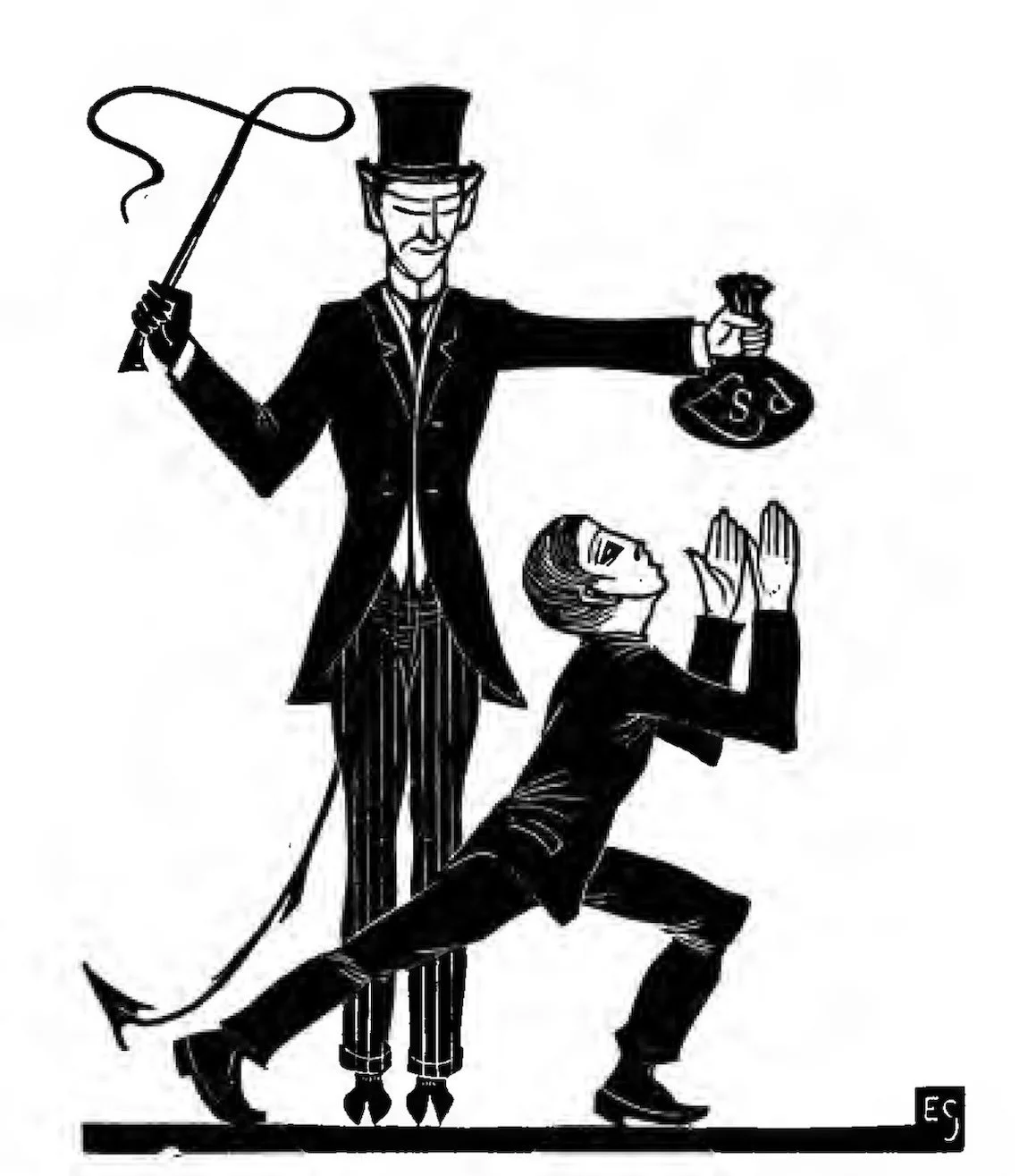
“The Money Bag and the Whip” (1915). Engraving by Eric Gill via Wikimedia Commons
More than any other ideology, economic materialism fits Karl Marx’s idea of ideology: it both hides and fuels the exploitative character of capitalism. Yet it also lines up with what Goudzwaard means by ideology: a societal tendency to absolutize certain goals by redefining values and norms and stipulating the means to meet those goals (p. 33). If unending economic growth becomes our overriding goal, then concerns about Earth care, equity, and eliminating poverty will always take a back seat.
That’s exactly what’s playing out in the current war on Iran. The Trump administration has already demonstrated in countless ways that it does not care about the environment, social justice, and human rights. Now it seeks new channels to funnel endless profits into corporate accounts and line the pockets of powerful billionaires. This is, as Paul Krugman has written, The Billionaires’ War.
How can this be accomplished? By gaining more control over the resources they favor: petroleum, AI infrastructure, and global trade. The fact that Iran has fought back by shutting down the Strait of Hormuz indicates just how much, economically, is riding on this war—as do Trump’s criminal threats to retaliate by blasting away at the country’s electricity and water plants.
High-Tech Militarism
The Trump and Netanyahu administrations operate under the illusion that high-tech weaponry can solve low-tech problems, as if bombing a country to smithereens will eliminate the widespread suffering that drives people to make desperate moves. That’s because they, like Russia, China, and much of the Western world, remain in the grip of another pervasive ideology: high-tech militarism. Goudzwaard tells the history of this ideology as an ever-expanding search to guarantee national security through military means.
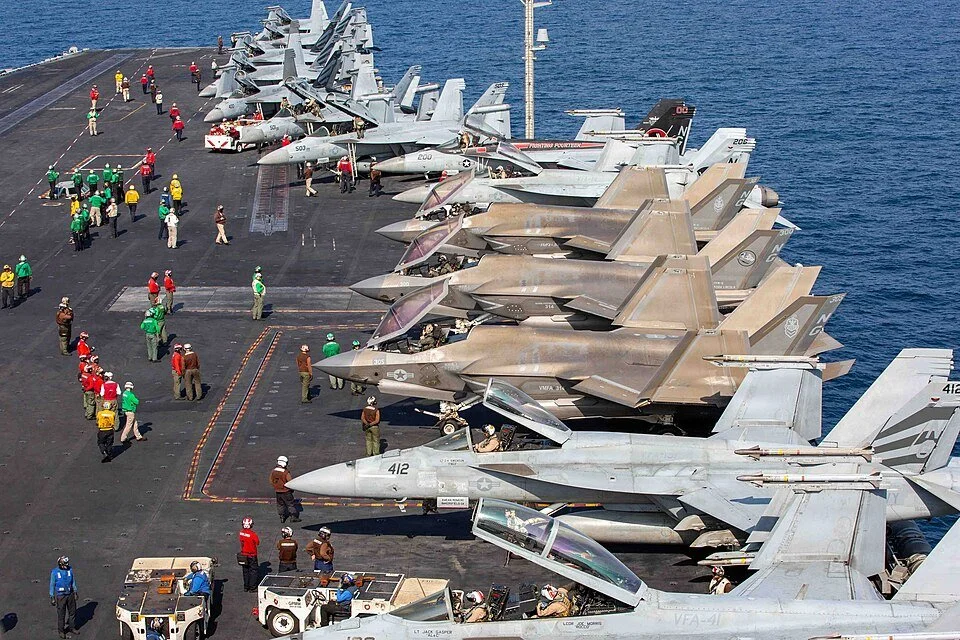
Fighter jets on the flight deck of aircraft carrier USS Abraham Lincoln in support of Operation Epic Fury, February 28, 2026. U.S. Navy photo via Wikimedia Commons.
Together, the United States, China, and Russia commit approximately $2 trillion to their annual military budgets. This amount far outstrips what they spend on social services and meeting human needs. Moreover, smaller and mid-sized countries like Canada quickly succumb to pressure to beef up their own military profiles. As a result, the world has entered another arms race, one that extends from earthbound battlefields to cybersecurity and outer space.
Here’s the thing. High-tech weapons need to be tested, and their cost needs to be justified. There’s no better way to do both than to try them out in small-scale skirmishes (e.g., in Venezuela) or enter all-out wars (e.g., with Iran). Although the Trump and Netanyahu administrations won’t say they started this war to try out their latest military toys, the mixture of war footage with video games in recent American military messaging suggests just such a callous and calculating fantasy.
Turnaround
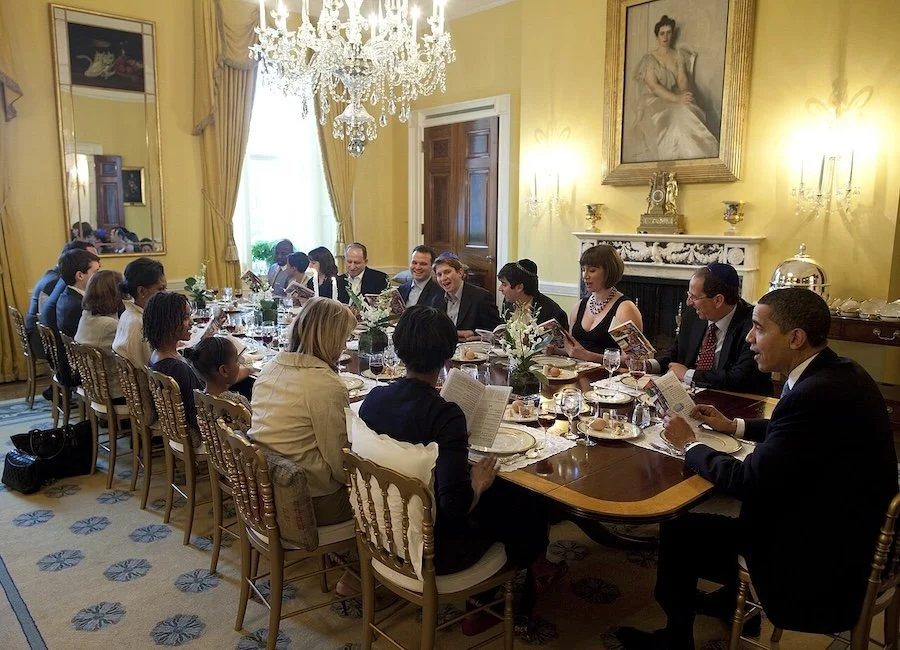
President Barack Obama hosting a Passover Seder Dinner at the White House on April 9, 2009. Official White House photo by Pete Souza via Wikimedia Commons.
Countries controlled by group identitarians, committed to endless prosperity, and gripped by high-tech militarism cannot walk the pathways of solidarity, stewardship, and justice. The roads they do ride, under ideological clouds, lead to destruction and death. Citizens of such countries need to turn around, in good Lenten, Passover, and Ramadan fashion, and head toward life-giving light. Maybe, in time, our benighted leaders will follow.
Note: I notify a list of readers when a new blog post is published. If you’re not on that list and wish to join us, please let me know via the Contact button at the top of this page.