Blessing and Comfort: A German Requiem
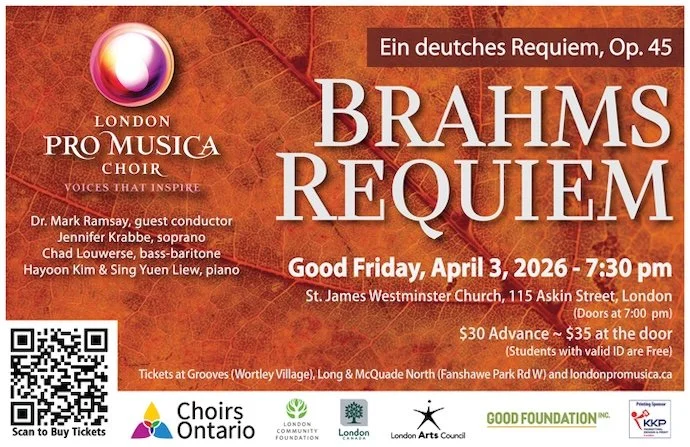
A German Requiem by Johannes Brahms (1833-1897) provides an antidote to the poisonous ideologies of warfare described in my previous post. At least that’s what I experienced while singing it with the London Pro Musica Choir on Good Friday this year. We performed the Requiem exactly 129 years after Brahms died (April 3, 1897) and 158 years after he conducted its first complete performance, on a Good Friday (April 10, 1868), in Bremen, Germany.
Our Only Comfort?
Contemporary ideologies of warfare—group identitarianism, economic materialism, and high-tech militarism—drive people to seek their blessing by upholding a select group of people (e.g., patriarchal white Christian Americans), pursuing endless economic growth, and securing national “freedom” through the latest military means. The new Iran War, though temporarily suspended, shows these destructive ideological forces at work.
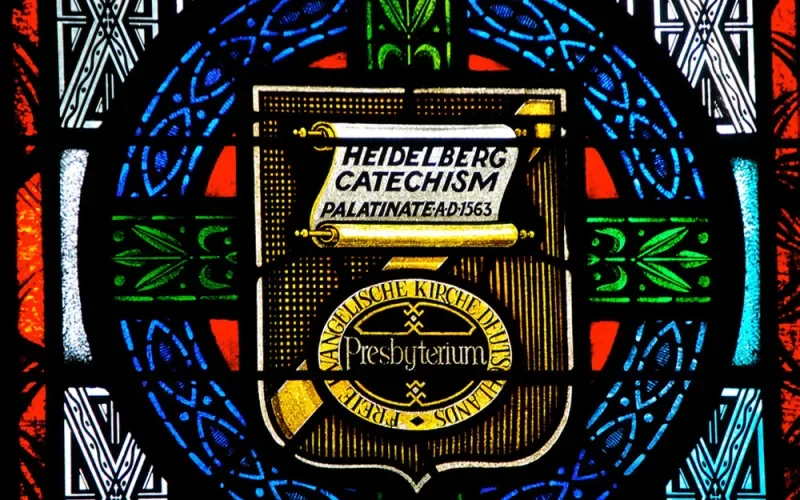
As a child and teenager in north central California, I heard countless sermons based on the Heidelberg Catechism. This is a summation of Christian teachings in question-and-answer format that stemmed from the German Calvinist Reformation in 1563. Here is the first question, which people like me know by heart: “What is your only comfort in life and death?” The answer we learned is not that we belong to the “greatest” (white Christian) nation on earth and enjoy all the privileges of wealth and power this bestows.
That’s also not the answer A German Requiem gives, even though Brahms was a German nationalist, and early performances of his Requiem occurred during the Franco-Prussian War (1870-1871) when a German Empire (Deutsches Reich) consolidated under Prussian King Wilhelm I and Chancellor Otto von Bismarck. No. From beginning to end, A German Requiem assures us that genuine comfort, both in life and in death, comes to “those who mourn” and those who “die in the Lord.” Everything else is “vanity” and a “vain show,” including all the strivings for group superiority, prosperity, and might that contemporary ideologies urge upon us.
Questions of Interpretation
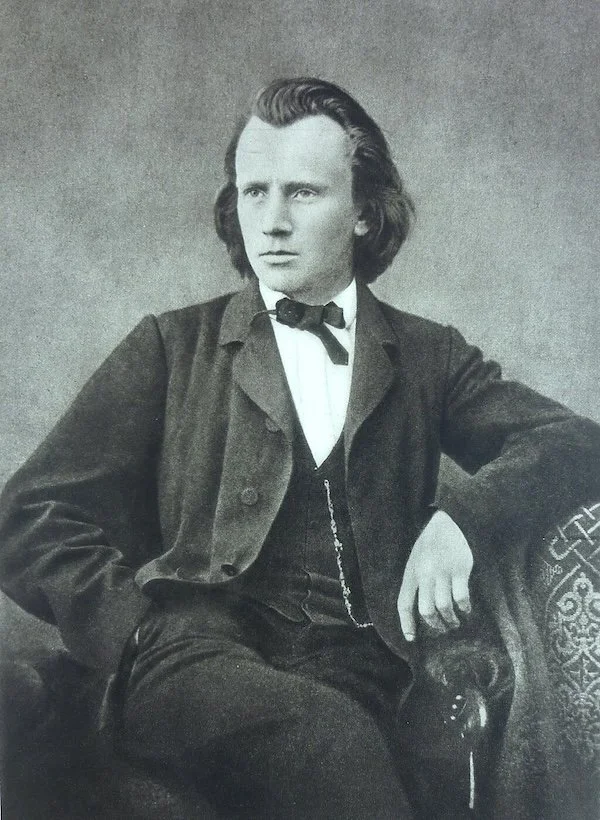
Johannes Brahms, Public domain, via Wikimedia Commons
Compared with most requiems composed before 1868, Brahms’s is unique. That’s clear from its full title: Ein deutsches Requiem, nach Worten der heiligen Schrift (A German Requiem, to Words of Holy Scripture). Die heilige Schrift is what Martin Luther titled his translation of the Bible into German, the source of Brahms’s texts. Most requiems before this used Latin texts that came not from the Bible but from the liturgy of the Roman Catholic mass for the dead.
Like Brahms’s Requiem, Handel’s Messiah also uses biblical texts in a vernacular language. But Messiah is not a requiem and, as an earlier blog post discussed, the composer did not assemble its libretto. Brahms, however, created his entire compilation, calling on intimate biblical knowledge as a well-trained Lutheran to artfully interweave passages from both the Old and New Testaments. Indeed, this is a German Protestant requiem, not only in its libretto but also in its indebtedness to a church music tradition that included Heinrich Schütz (1585-1672), Johan Sebastion Bach (1685-1750), Felix Mendelssohn (1809-1847), and the Lutheran chorales they all used and loved.
This specifically Protestant Christian heritage raises a question for contemporary performers. Should we downplay the work’s particular religious background in order to help it speak to a religiously mixed or secular audience? Or should we highlight that background in the interests of historical authenticity and risk losing or offending our audience?
Behind this question lies a scholarly debate about the work’s religious character. We can label the two camps in this debate the universalists and the orthodox. Universalists argue that Brahms wanted to create a “human Requiem,” not a German Protestant requiem, one that can “stand above all religions, confessions, and worldviews. Brahms attempts to find a basic statement about suffering, death, and resurrection that has validity for all people” [Hanns Christian Steckel, quoted in R. Allen Lott, Brahms’s A German Requiem(Rochester University Press, 2020), 7]. That’s the position taken, for example, by Michael Musgrave in Brahms: A German Requiem (Cambridge University Press, 1996), and it’s the majority opinion among musicologists today.
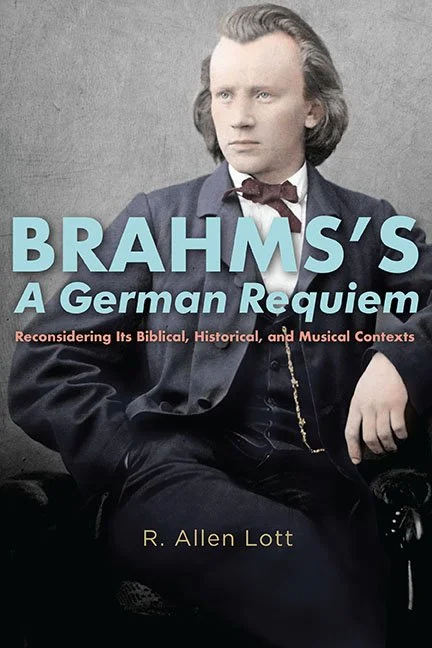
The orthodox think this is sheer nonsense. The question is not what Brahms intended—which in any case is difficult to discern—but rather what the music and texts mean and how they were presented and understood in their original German Lutheran context. When you reconstruct this meaning and context, as R. Allen Lott does in painstaking detail, then “the obvious Christian significance cannot be obliterated, not even by pronouncements from a host of musicologists” (Lott, 331).
Given this debate, perhaps the best that performers can do now is to recognize both the Protestant Christian embeddedness of A German Requiem and its more universal appeal. The program notes by Dr. Ernest Redekop for London Pro Musica’s recent performance make that move: “In Brahms’s use of texts from the Bible, [A German Requiem] is thoroughly Protestant and at the same time catholic [i.e., universal] in its depiction of life, death, and an after-life.”
There’s also something personal about how people experience Brahms’s Requiem. We know the untimely death of Robert Schumann, his mentor, in July 1856, and his mother, to whom he was close, in February 1865, weighed heavily on Brahms when he wrote this work (1865-1868). And the structure of the work encourages us to connect it with our own loss of loved ones: it moves through seven movements from blessing those who mourn to blessing those who have left us.
Doing research for this blog post, I discovered an additional reason why the first and last movements resonate so deeply. Although the reason is personal, perhaps it will speak to your own experience. To explain it, I need to wander into the musical and textual weeds. That’s where I love to roam, as I’ve explained in blog posts on Dan Forrest’s Requiem for the Living and on several pieces by Morten Lauridsen. Hopefully we won’t get lost.
Mirror Structure
Let me focus on the opening of the first movement and the end of the last (movement 7). Here are the words for these two passages and their translations into English (I use the New Revised Standard Version of the Bible):
Movement 1 (Matthew 5:4)
Selig sind, die da Leid tragen, denn sie sollen getröstet werden.
Blessed are those who mourn, for they will be comforted.
Movement 7 (Revelation 14:13)
Selig sind die Toten, die in dem Herrn sterben …
Blessed are the dead who … die in the Lord.

Photo by Михаил Секацкий on Unsplash
Thematically and harmonically, A German Requiem has what Musgrave calls a “mirror structure” (19). Each later movement elaborates textual and musical ideas in the earlier movement(s) it mirrors. Movement 7 mirrors movements 1 and 2; movement 6 mirrors movement 3 (both of which are for baritone soloist and chorus); and movements 4 and 5 form the mutually reinforcing center of the work.
I won’t go into details about harmonic structure. [Musgrave gives a succinct technical account in a chapter titled “The Work as a Whole” (14-34).] Except to point out the significance of the work’s beginning and ending in F major. Traditionally, F major is associated with gentleness and calm. Lott describes the F major tonality of movements 1 and 7 as “a soothing, pastoral key appropriate for the comforting words offered in both movements” (291).
It’s also notable that Brahms begins his Requiem in a major key. This distinguishes it from nearly all previous requiems, which begin in minor keys. Also, even when other of his movements begin in minor keys, all end in major keys, with texts that speak of joy (movement 2), deliverance (3), and praise (6). Clearly, Brahms aimed to convey blessing and comfort, not doom and gloom.
Blessing and Comfort
In fact, the primary melodic pattern structuring this work is what musicologists call the “Selig” motive (Selig being the German word for “blessed” that opens and closes this requiem). Consisting of three notes, it’s first sung by the sopranos when the chorus enters a cappella in movement 1, after a 14-measure orchestral introduction. This simple pattern, spanning a fourth and set to the words Selig sind (Blessed are), slowly rises from the scale’s tonic and comes to rest at the subdominant: F – A – B♭. (I have linked a performance by the Mogens Dahl Kammerkor, accompanied by a piano duet rather than orchestra. That’s the instrumental arrangement we used in the London Pro Musica Choir concert; it lets the vocal lines stand out more clearly than a full orchestra would.)
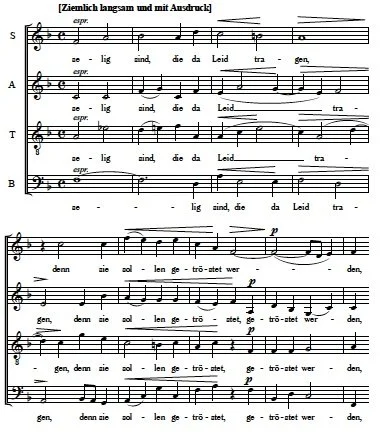
A German Requiem, movement 1, mm. 19-27
After a measure’s rest, the pattern begins again at measure 19, less slowly now, and blossoms into a melodic phrase on the words die da Leid tragen (those who mourn) that begins on A (the second note of the “Selig” motive), jumps a fourth, and then descends to that same second note: A – D – C – B – A. The concluding phrase of this opening melody is set to denn sie sollen getröstetwerden (for they will be comforted). It begins even higher and jumps another fourth before descending an octave to the tonic on which the entire passage began: C – F – E – D – E – C – A – F – D – E – F.
This is brilliant and compelling vocal writing. Using three upward jumps of a fourth, each one higher than the last, Brahms ushers us into the quiet of blessing (Selig sind), the sorrow of suffering (die da Leid tragen), the hope of joy (denn sie sollen), and the reassurance of comfort (getröstet werden). I suggest you listen to the opening orchestral and vocal statements (measures 1-28) several times to let this melody and its surrounding texture sink in.
Genevan Tune
One could multiply this example of compositional genius many times over. But I want to say why I find Brahms’s use of the “Selig” motive so moving. When I was a graduate student in Toronto during the 1970s, I wrote a seminar paper on what biblical scholars call Deutero-Isaiah (Isaiah 40-55). I was especially attracted to the opening verses, which read like a radio drama (Isaiah 40:1-11). They begin with words made famous by the first tenor aria in Handel’s Messiah: “Comfort, comfort ye my people.”

Hebrew scroll of the book of Isaiah. Photo by Pete Unseth via Wikimedia Commons
In fact, Messiah quotes liberally from this passage, including verses 1-5 in the opening tenor solos and the chorus “And the Glory of the Lord”; 9 in the alto solo and chorus “O Thou That Tellest Good Tidings to Zion”; and 11 in the soprano solo “He Shall Feed His Flock.” I’ve written previously about how Handel’s music seeped into my experience as a young person and how singing it profoundly moved me this past Advent season. Brahms was also well-versed in Handel’s Messiah; movement 2 of his Requiem indirectly uses verses from the same passage (Isaiah 40:6b, 8, as quoted in 1 Peter 1:24-25a) to contrast the transience of human life and the reliability of God’s good news.
Around the time I wrote the paper on Deutero-Isaiah I became fascinated by original tunes from the sixteenth-century Genevan Psalter. My mentor, Calvin Seerveld, wanted to return these tunes, in their vigorous early versions, to liturgical prominence. One tune in particular caught my attention. It sets the words that open Deutero-Isaiah. Here’s how the first stanza of a recent versification reads (I’ve linked to a slightly different version, with melody and text displayed, that was recorded during the COVID pandemic):
Comfort, comfort now my people; speak of peace: so says our God.
Comfort those who sit in darkness, mourning under sorrow’s load.
Cry out to Jerusalem of the peace that waits for them;
Tell her that her sins I cover and her warfare now is over. (Psalter Hymnal, 1987, No. 194)
Later I learned from my mother that she had hummed this tune to me as a lullaby when I was an infant. It was the tune for Psalm 42 in her Dutch Psalter. That versification begins as follows (with older Dutch spellings; the English version is my rough translation):

“Psalm 42/43.” Linocut print by Henk Krijger (1973).
‘t Hijgend hert, der jagt ontkomen,
Schreeuwt niet sterker naar ‘t genot
Van de frissche waterstroomen,
Dan mijn ziel verlangt naar God.
No hart, escaping the hunt,
Screams louder for the pleasure
Of freshwater streams,
Than my soul longs for God.
A contemporary English versification, not as dramatic as the Dutch one, begins: “As a deer in want of water, so I long for you, O Lord” (Psalter Hymnal, 1987, No. 42).
Lutheran Chorale
I’ve recently rediscovered that the same tune, rhythmically modified, appears in a prominent Lutheran chorale: “Freu dich sehr, O meine Seele” (Rejoice greatly, o my soul). Johan Sebastian Bach used this chorale in eight different cantatas, and Brahms would have known it well. The same tune occurs in the Lutheran chorale “Tröstet, tröstet, meine Lieben” (Comfort, comfort, my beloved), the German versification of Isaiah 40:1-5. You can hear an example of Bach’s usage in his cantata Meine Seufzen, Meine Tränen, Movement 3.
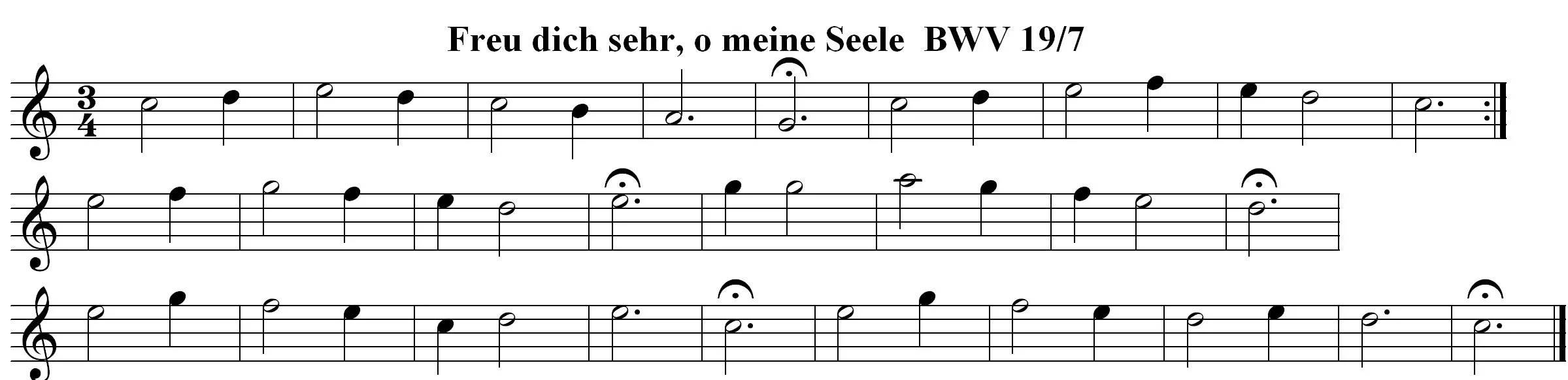
Notation of melody to the Lutheran chorale “Freu dich sehr, O meine Seele”
Brahms told his friend Siegfried Ochs that a Lutheran chorale had inspired his writing of A German Requiem. But he did not say which one. Recent scholarship suggests that “Freu dich sehr, O meine Seele” or “Tröstet, tröstet, meine Lieben” might be the one (see Lott, pp. 268-273). The melody in the instrumental introduction to Requiem movement 1, appearing in ever higher voices, takes the exact tonal shape of the first phrase to “Comfort, Comfort, Now My People”: F – G – A – G – F – E – D. But then it goes up to an E instead of down to a C. The “Selig” motive (F – A – B♭) outlines the shape of the Genevan tune’s next new phrase: F – G – A - B♭ - A – G – F. And the rise and fall of the Requiem’s entire opening soprano melody resembles the rise and fall of the Genevan tune; both of them start and end on the tonic F, although the Requiem melody goes two notes higher.
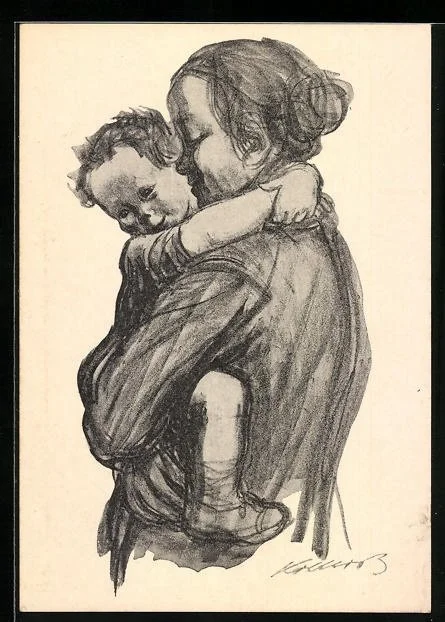
“Mother with Child.” Lithograph by Käthe Kollwitz, 1931.
We know early childhood experiences shape us for life. Here’s what I’ve recently discovered: The tune my mother hummed to me from her Dutch Calvinist tradition not only imprinted itself in my psyche but also resonates with the comfort that Isaiah, Handel, Bach, and Brahms offer. And the bodily memory of her lullaby adds personal significance when the choir sings a hushed response to the soprano solo in movement 5 (minute 35:30 in the linked recording): “Ich will euch trösten, wie einen seine Mutter tröstet” (“As a mother comforts her child, so I will comfort you,” Isaiah 66:13, NRSV).
A German Requiem offers comfort for those who mourn, indeed, for those who suffer (as we could translate die da Leid tragen). That’s not a fanciful invention. Nor is it vague wish fulfillment. The comfort is right there in the music, in the Genevan tune, in the Lutheran chorale, in Brahms’s “Selig” motive.
Revisit the Requiem’s first movement with this in mind. Then listen to the last movement (minute 51:50 in the linked recording), where the sopranos begin with a downward inversion of the “Selig” motive (F – D – C). At the end, the last syllable of Selig brings all voices together on a unison F. May all of us so find blessing and comfort.
Note: I notify a list of readers when a new blog post is published. If you’re not on that list and wish to join us, please let me know via the Contact button at the top of this page.