America’s War on Iran: Listening Past the Noise
Less than three weeks have passed since I posted about deeply entrenched ideologies and asked how we should resist societal evil. Tipping my hat to two Bobs—Bob Goudzwaard and Bob Dylan—I titled the post Slow Train Coming.
Societal Catastrophe
Photo by Christian Buehner on Unsplash
Yet the societal catastrophe bearing down on us doesn’t seem slow at all. It has accelerated. On February 12 the Trump administration declared that greenhouse gas emissions do not endanger human health and the environment, thereby rejecting what most scientists say and gutting federal regulations that limit such pollution. Five days later the broadcast network CBS, most likely under pressure from the White House, pulled Stephen Colbert’s late-night interview with James Talarico, whose politics of love I discussed in a previous post. (Posted on YouTube instead, the interview has received nine million views, more than three times the usual viewership for Colbert’s show!)
The same week, the U.S. Supreme Court struck down tariffs Donald Trump had illegitimately imposed on more than 100 countries, only to have him quickly announce a new 10% tariff on most global imports. Journalists and politicians have expressed mounting fears that Trump and his supporters will subvert or block the upcoming midterm elections. And, just a few days ago, the United States and Israel launched unprovoked and aggressive attacks on Iran, killing Ayatollah Ali Khamenei and prompting Iranian counterattacks on U.S. allies and military bases throughout the Middle East.
That’s a lot to take in, and there’s no end in sight. I’d like to suggest a way to view these events that can put them into focus and help guide our responses. Let me use the new war on Iran as a primary lens. What’s going on here? How should we respond?
Pragmatic Concerns
There are five ways to evaluate the recent decision to attack Iran: motivational, consequential, principial, ideological, and directional. Most of the news articles and commentaries I’ve read concentrate on the first two: What has motivated the Trump administration to launch these attacks? What will be their likely consequences? Are these motivations and likely consequences legitimate?
Even if we limit our attention to motivations and consequences, the new war on Iran seems illegitimate. Trump has mentioned two motivations: to counter Iran’s nuclear threat to American interests, and to bring about a change in Iran’s government. Neither warrants an all-out air assault on Iranian cities and military targets, especially not one the U.S. Congress has not debated and authorized, the international community has not been asked to support, and for which the American people have not received adequate information and rationale.
Image by zbyněk baladrán, via Wikimedia Commons
That raises questions about what Trump’s actual motivations might be. The two most plausible answers, both mentioned by historian Timothy Snyder in a recent blog and a column in The Globe and Mail, are to continue subverting American democracy and to further enrich Trump and his oligarchic friends. By creating an international “emergency,” the Trump administration can “justify” not only federal interventions in the 2026 midterm elections but also more drastic controls on all public and social media—the recent brouhaha at CBS is just the beginning.
Moreover, as Snyder says in his column, “The Gulf monarchies that oppose Iranian power have lavished Mr. Trump and his family with huge business deals.” That might be the second motivation, namely, widespread political corruption: the administration is using American military might as payback for Middle Eastern favors. Because the President has not given adequate public explanations, we need to consider such hidden motivations.
Similarly, questions about likely consequences raise many red flags. The congressionally unauthorized war strengthens Trump’s ability to burst through constitutional constraints and avoid public deliberation. By themselves, the attacks on Iran will not bring about the sort of regime change that Trump supposedly wants, as columnists Nicholas Kristof and Doug Saunders clearly explain. But they will needlessly kill many people and destroy many lives.
The attacks will also increase political and military conflicts throughout the Middle East and beyond. And they will shatter any pretense that the United States and its allies care about the international rule of law—something Prime Minister Mark Carney should have considered more carefully before he hastily announced Canadian support for American aggression.
Questions of Principle
Without going into counterarguments like those columnist Bret Stephens has detailed in the New York Times, I think there are enough unanswered questions about motives and consequences for us to consider the war on Iran illegitimate. That’s without even touching the issue of whether and, if so, when it’s ever legitimate to launch a war of choice on another country—not to mention the likelihood, as Charlie Savage shows, that killing a foreign leader such as the Ayatollah violates both American and international law.

Photo by 愚木混株 Yumu on Unsplash
It’s important to note, however, that pragmatic debates about motives and consequences prevail in North American journalism and politics. The noise of such pragmatic kerfuffles can be so loud that we ignore questions of principle, ideology, and direction rustling in the background. Let me talk about questions of principle first, saving ones about ideology and direction for a subsequent post.
My earlier blog posts on deceitful power and political truth pointed to three sorts of principial questions about politics. One concerns the societal principle of justice. Another pertains to the societal achievement of freedom. And a third addresses the justifiability of exercising political power. Although such questions initially arise in the contexts of local, regional, and national politics, modified versions of them pertain to the arena of international relations as well.
Global Justice
Now I’m no expert in this arena, and I’ll defer to those who are. Yet it seems to me that, beyond questions of motives and consequences and even before them, we must ask whether and how attacking Iran serves the cause of justice. What would a more just international order look like? Would this war—or any war for that matter—bring the world closer to it? How and why?
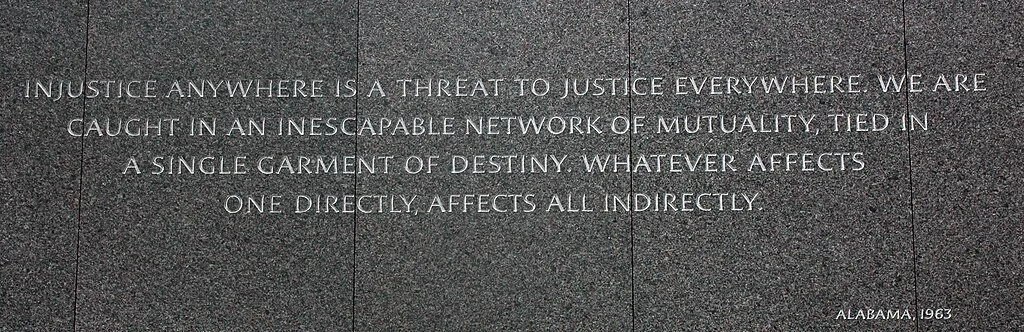
North Wall inscription, Martin Luther King, Jr. National Memorial, Washington, DC. Photo from National Park Service via Wikimedia Commons.
In a just international order, the legitimate interests of every country would be honored in relationship to those of all others. Further, every country would be accountable both for upholding the rights of its inhabitants and for addressing global challenges of poverty, the environment, criminal justice, immigration, and the like. The world is nowhere near such an order, despite dedicated and inspiring efforts over the past 80 years. Yet the societal principle of global justice, if I may call it that, remains a key consideration whenever conflicts between countries arise.
So far as I can tell, the Trump administration never raises such questions. Instead, in both policy and practice, whether at home or abroad, it believes that might makes right. In that sense, justice does not matter. In fact, as Peter Beinart has argued, Trump’s imperialist foreign policy mirrors and reinforces his domestic agenda: “both feature spectacular violence and contempt for the restraints of law.” This should disturb all justice-seekers.
I, for one, cannot see how attacking Iran serves the cause of global justice. It may shift the balance of political power inside Iran. It might even open a few doorways for Iranians to assert their rights. But it will do nothing to address the global challenges just mentioned, and it will do much to make them worse.
Freedom to Flourish
Something similar can be said about achieving freedom. Supporters of the current American war effort make much of the fact that the Iranian regime has ruthlessly repressed its people. Hence a war of choice is warranted to liberate them from their oppression. And there’s something to that.
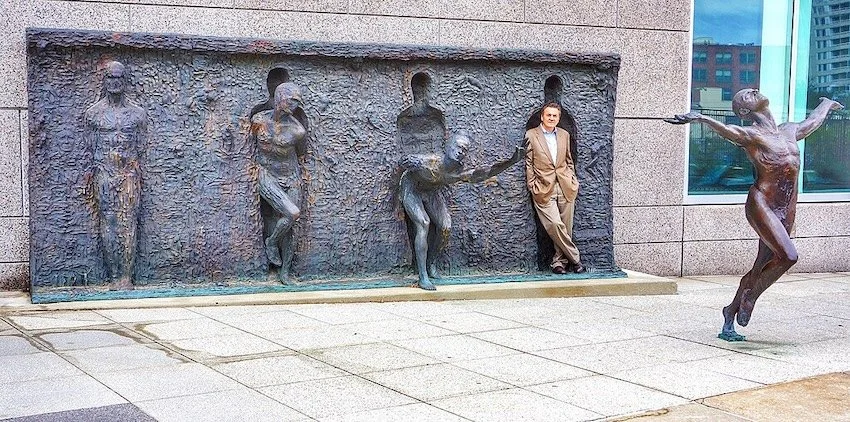
The Freedom Sculpture with sculptor Zenos Frudakis, via Wikimedia Commons. Photo credit: Rosalie Frudakis
But the problem, as I see it, is that liberation from political oppression is not the same as the freedom of Iranians to flourish, and no country outside of Iran has either the right or the responsibility to set the terms of such freedom. Yet that, in effect, is what the United States and Israel are trying to do, in a brutal and haphazard way. Besides, the attackers don’t really have the best interests of Iranians in view. Even if they did, they’d be mistaken to pursue such interests by military means.
This implies, in turn, that the entire war effort fails the test of justifiability. In principle, there’s no justification for the attack on Iran. In cannot be justified with regard to either justice or freedom. Nor has the Trump administration even attempted such a justification. And that tells us something about the ideological and directional issues at stake—the topic of my next blog post.
In the meantime, I encourage all of us to keep listening for what lies behind the rhetoric of motives and consequences. Don’t be fooled by either the administration’s bravura or the commentators’ pragmatism. Let’s ask instead what global justice and genuine freedom truly require.
Note: I notify a list of readers when a new blog post is published. If you’re not on that list and wish to join us, please let me know via the Contact button at the top of this page.