Slow Train Coming: How to Resist Societal Evil
My previous blog post asked how people should respond to the fact that huge swaths of American Evangelicals embrace or support the ideology of Christian white nationalism: Can people committed to following Jesus along the pathways of love and justice continue to call themselves Christians? Not surprisingly, this question has elicited a wide range of impassioned replies, in both personal emails and public comments. I’ll summarize the replies a little later.
First, however, I want to acknowledge that some readers don’t find this topic compelling. Perhaps you’ve never considered yourself a Christian. Or maybe you once did, but for good reasons no longer do. If so, you might regard this discussion mildly interesting at best or, at worst, depressingly parochial or benighted.
I understand such responses and don’t discount them. Nevertheless, I hope to show how my original question about the name “Christian” points to an issue that affects all of us, no matter what our religious convictions and spiritual orientations.
What’s In a Name?
The replies to my original question fall into three groups. The first group involves readers I would call fellow travelers. They share my agony about the white nationalist corruption of American Christianity and want nothing to do with it. Some also point out that, historically and globally, “Christian” has often been associated with the oppressors; the oppressed, such as some indigenous peoples in North America, have rightly rejected this label.
A second group includes people who share my opposition to Christian white nationalism but follow Martin Luther in refusing to let the devil have all the good tunes. In other words, like the Hebrew prophets, they want to call out the false religion of their fellow believers and reclaim the name “Christian” for those who truly follow Jesus in their politics. We can call this group the prophetic resisters.
In the third group are Christians who aren’t so concerned about how to label themselves—“follower of Jesus,” for example, will do just fine—but they want to be authentic in how they practice what they preach. For some of these readers, however, my commitment to “following the pathways of love and justice that Jesus pioneered” might not be sufficiently authentic; they find it smacks of “Christian humanism.” We can call this group the personal followers.
All of these groups offer thoughtful responses to the dilemma I posed. I don’t plan to debate them. Instead, I want to dig deeper into the dilemma itself. For the issue we face is not simply the familiar Shakespearean question, “What’s in a name?” Rather, the deeper issue is how to resist an entrenched ideology and challenge the societal evil this ideology embodies and fosters. Moreover, Christian white nationalism is not the only ideology to resist.
Faith and Ideologies

Bob Goudzwaard (1934-2024)
To frame this issue, let me quickly review relevant writings by the late Dutch reformational economist and social philosopher Bob Goudzwaard (1934-2024). (For more information about him, read the linked In Memoriam published by the Institute for Christian Studies, where I did my graduate studies and later taught.) Fifty years ago Goudzwaard published a pathbreaking book titled Kapitalism en vooruitgang. Three years later it appeared in English as Capitalism and Progress: A Diagnosis of Western Society (Eerdmans, 1979), translated by Josina Van Nuis Zylstra. (A new collection of essays on this book is in the works—here’s a link to information about that.)
Goudzwaard’s book argues in sweeping detail that the modern capitalist economy draws on a deeply spiritual faith in humanly achievable progress. Moreover, we cannot adequately address the intractable structural problems confronting capitalist societies—environmental destruction, high inflation paired with high unemployment, widespread alienation, and the like—unless we undergo a spiritual conversion away from our faith in progress.
Goudzwaard showed the practical relevance of this diagnosis a few years later, in a 1981 book translated by social worker Mark Vander Vennen as Idols of Our Time (Inter-Varsity Press, 1984). Challenging the neoliberal heyday of Margaret Thatcher and Ronald Reagan, Goudzwaard showed that several complex and interlinked ideologies have a grip on Western society. Through them, powerful idolatries have come to life. Two decades later, joined by political scientist David Van Heemst, Goudzwaard and Vander Vennen updated this account for a post-9/11 world, in a book titled Hope in Troubled Times: A New Vision for Confronting Global Crises (Baker Academic, 2007).
Last week, the responses to my most recent blog post prompted me to reread Hope in Troubled Times. Goudzwaard’s other two books appeared early in my teaching career, and I used them as textbooks in interdisciplinary courses at The King’s College (now University) in Edmonton, Alberta and Calvin College (now University) in Grand Rapids, Michigan. But Hope in Troubled Times has sat on my bookshelf, unstudied and untaught, for nearly two decades, awaiting an appropriate “teachable moment.” That time has come.
Idols of Progress
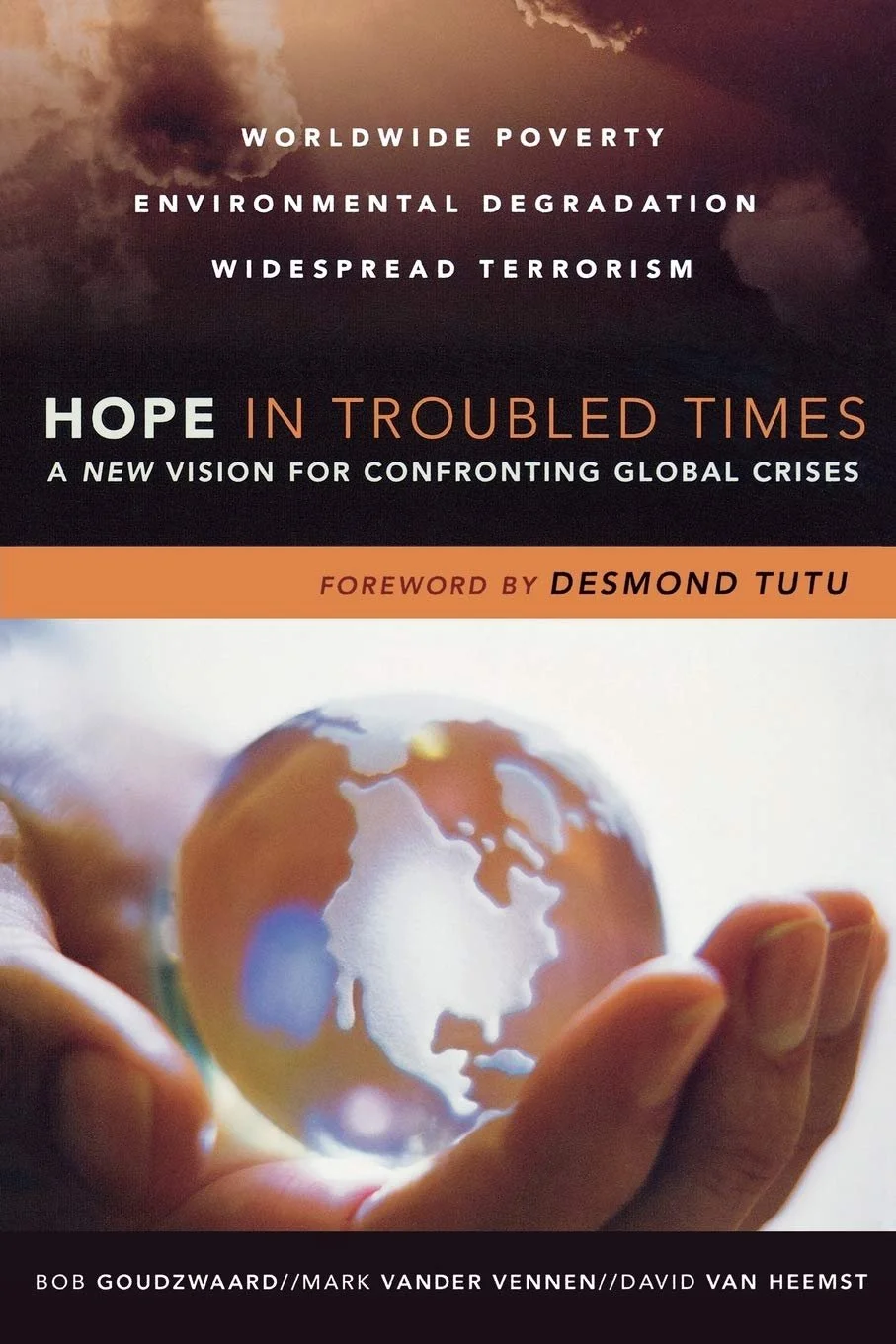
Although written in an accessible style, Hope in Troubled Times has many layers. I would need more than one blog post to summarize it well. But let me highlight a few interconnected claims that address our present moment.
First, the book argues that structural problems having to do with environmental devastation, widespread violence, and global poverty seem intractable because we try to solve them using the same tools of “progress” that helped create them in the first place. Hence, for example, Western countries have tried to throw money at global poverty when the very mechanisms of international finance, which these countries control, help create it.
Second, we keep relying on our economic, technological, and scientific tools because we have faith in them as the keys to progress. Third, this faith turns the tools of progress into idols, and these idols take control of our lives and social institutions. They take control via the heartfelt ideologies of group identity (e.g., Islamism, Zionism, and Christian white nationalism), endless economic growth and prosperity, and guaranteed national or international security. Although such ideologies arise in response to dire needs, they inexorably conscript the “values of truth, justice, and love” for their own purposes (p. 111 and elsewhere).
The ideologies Goudzwaard diagnosed in the early 1980s and redescribed in 2007 have neither dissipated nor lost their grip. We need to situate resistance to Christian white nationalism in this context.
Crisis of Faith
I do not doubt that Christian white nationalists, having made an idol of political power, now worship it “in the name of Christ,” as James Talarico has suggested. Yet they do this within a society where all of us, whether we want to or not, support the complementary ideologies of unending wealth and guaranteed security.

Photo by Saif71.com on Unsplash
We might not display the unfiltered greed of Trump and his oligarchs. We also might not support their openly imperialist designs on other countries. But we do belong to countries where economic growth supersedes ecological care and where military armaments and alliances outweigh tangible support for immigrants and refugees. Global poverty, environmental devastation, and the militarization of social conflicts would not be so entrenched if we did not bow down to wealth and power.
In this sense, the crisis of faith described in my previous blog post affects all of us, regardless of whether we claim, avoid, or reject the label “Christian.” For the ideologies of wealth and power that have us in their grip both block and subvert our best efforts to follow the pathways of love and justice. They have us in their clutches because of a misplaced faith.
Deliver Us from Evil
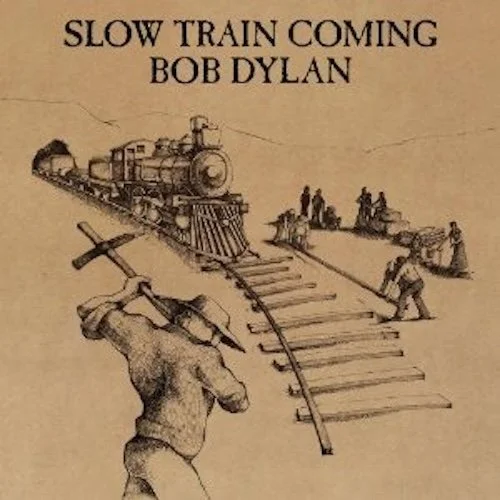
In 1979, the year Capitalism and Progress appeared in English, Bob Dylan released his album Slow Train Coming. There was much discussion at the time about whether and how this album expressed his conversion to Christianity. I’ve always found those discussions beside the point. Singing sardonic and riveting lyrics with a powerhouse combo and backup vocals, Dylan addresses the deepest crisis of faith that all of us face.
In this sense it doesn’t matter what religious label he or we might wear. If we’re committed to the ways of love and justice, we continually face the dilemma the album’s opening track poses: “Well, it may be the Devil and it may be the Lord / But you're gonna have to serve somebody.” (Be sure to listen to the linked recording of Bob Dylan’s “Gotta Serve Somebody”!)
Here’s the dilemma: It might be quite clear what love and justice require. Yet the pathways to them often seem blocked. They seem blocked due to the ideologies that possess us and point our countries and communities in life-destroying directions. As a result, all of us must confront what I call societal evil—evil that becomes embedded in our cultural practices and social institutions and, gathering strength, comes to dominate an entire society, even as it remains hard to recognize and resist. (For elaborations, see my books Religion, Truth, and Social Transformation, 233-34, 319-23; Shattering Silos, 26-27, 98-100, 175-77; and Social Domains of Truth, 291-96.)
And that makes me wonder what those who wish to pursue love and justice, regardless of their religious identity, should do. Or, to put this in a liturgical language Christians recognize: What does it mean on a Sunday morning when congregations, reciting the Lord’s Prayer, pray in unison “And deliver us from evil”? What is our part in resisting societal evil?
Note: I notify a list of readers when a new blog post is published. If you’re not on that list and wish to join us, please let me know via the Contact button at the top of this page.