Justice, Freedom, and Power: The Truth of Politics
Two weeks ago I commented on a well-known essay by Hannah Arendt about “Truth and Politics” (1967). I said Arendt has raised crucial questions about conflicts between factual truthtellers such as journalists and scholars and the post-truth politics of Donald Trump. But I don’t think she successfully reimagined the relation between truth and politics.
The daily saga of Trump’s authoritarian populism makes it urgent to reimagine this relation. In just the past two weeks The New York Times has told how his administration channels the initiatives of wealthy billionaires like private equity titan Marc Rowan into direct pressure on schools and universities to align with Trump’s ideological agenda.
And The Washington Post has reported how numerous retired federal judges fear that his administration’s unrelenting attacks on judges it doesn’t like, and its persistent attempts to circumvent judicial rulings, “have pushed the courts and democracy to a fragile tipping point—one where cooperation with rulings and adherence to the rule of law can no longer be assumed.” Those are just two arenas—education and law—where factual truthtelling is under political attack.
Hannah Arendt asks how truth and politics relate because the political power of “organized lying” can make all pursuits of truth seem completely powerless. But if, as I suggested in my previous post, truth and politics are not as distinct as Arendt assumes—if instead the proper pursuit of political power actually serves the truth—then we need to reframe Arendt’s question. We need to ask about politics as a social domain of truth, alongside science, art, religion, and other social domains.
Strange as it might seem, politics itself could be a way to pursue truth. I’d like to explain how.
What Is Politics?
Madhav-Malhotra-003, CC0, via Wikimedia Commons
To begin, let me delimit “politics” by stipulating three overlapping meanings. First, politics in a very broad sense refers to any struggle for liberation from oppression, domination, exclusion, and the like. Such struggles are collective, not individual, and they usually last for more than a generation. One can speak in this sense of gender politics or identity politics.
Second, politics also refers to how people participate in informal networks of communication and influence regarding matters of public concern: how they discuss and advocate about issues in health care, climate change, a living wage, and the like. Politics in this sense pertains to the public sphere. Debates about the impact of new social media on young people and education, for example, raise political matters in the public sphere.
Third, and more traditionally, politics refers to activities and events within what political theorists call the state, understood broadly enough to include both governments and suprastate organizations connected to treaties, trade regulations, and the like.
Power and Justice

These three meanings might seem only loosely connected. Yet they share a deeper unity. For all involve both power and justice. Within all three forms of politics, people engage in power struggles in order to achieve justice, and they struggle over justice from positions of relative power. An oppressed minority fighting for its rights seeks sufficient power to pursue a just end, even as it tries to make that end an achievable goal.
The same pattern holds when a not-for-profit organization promotes new environmental regulations or a political party advances new tax legislation. All of them engage in politics as a power struggle over justice and a justice struggle over power. That is the general sense in which, from here on, I will talk about politics.
This means politics is never merely a matter of power. It is just as much about justice. Nor are concerns for justice ever nonpolitical, not even in the modes of factual truthtelling such as history and journalism that Arendt declared apolitical.
Moreover, politics in its most general meaning is intrinsically normative. In other words, it always raises concerns about what’s better and what’s worse for life in society, and it does that with respect to both power and justice. Struggles for power within the political domain always raise issues about whether the power exercised is both legitimate and appropriate to the ends of justice. At the same time, political struggles for justice always raise issues about the scope of the justice sought and whether it can be achieved. Both power issues and justice issues are normative matters.
Social Domain of Truth
This double normativity entails that, in principle, truth and politics do not conflict. Instead, as I now want to show, politics is a social domain of truth: pursuing truth is intrinsic to politics, and political efforts can contribute to the unfolding of truth as a whole.
My book Social Domains of Truth characterizes truth as a whole as a dynamic correlation between human fidelity to societal principles, on the one hand, and a life-giving disclosure of society, on the other. A life-giving disclosure is one that furthers the interconnected flourishing of all creatures. I’ve said more about this in my blog post Thinking Straight and Loving the Truth.
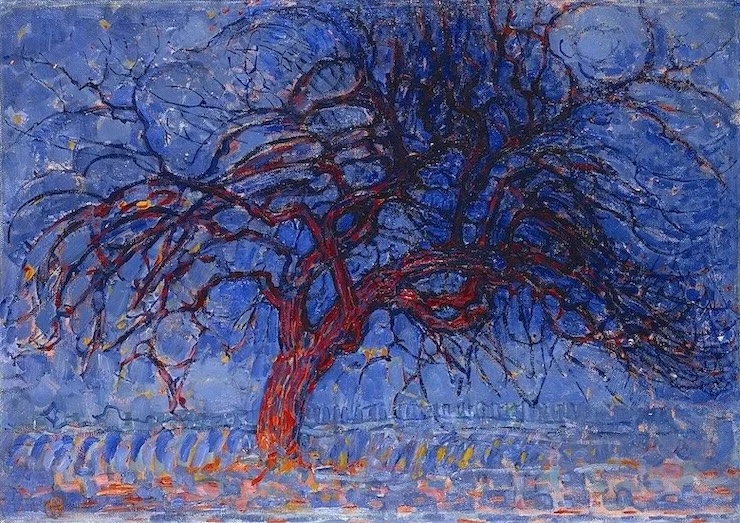
The Red Tree (1908-1910). Oil painting by Piet Mondrian, Public domain, via Wikimedia Commons
My book shows how this dynamic correlation unfolds in different social domains of truth such as science, art, and religion. While distinct, these domains are nevertheless isomorphic with one another and with truth as a whole. That is to say, in each one a distinct correlation between fidelity and disclosure echoes the correlations in other social domains and thereby participates in the dynamic correlation that makes up truth as a whole.
And, as the blog post just mentioned shows, propositional truth—the truth of propositions, assertions, and beliefs—also belongs to truth as a whole. It has its own sort of dynamic correlation, namely, between fidelity to the societal principle of logical validity and propositional disclosure of the objects about which we make assertions.
So when I say politics is a social domain of truth, I mean it is one among several distinct arenas where human beings can practice fidelity to societal principles and promote a life-giving disclosure of society. Specifically, the leading societal principle in the political domain to which truth requires fidelity is that of justice. And the most important way in which political efforts contribute to life-giving disclosure is by freeing people and other creatures from oppression.
As a social domain of truth, then, politics involves a dynamic correlation between justice and freedom. It is the domain where we pursue justice in order to achieve liberation, and where freedom from oppression depends on the degree to which our governments and other political practices and institutions are just.
Political Truth and Justifiable Power
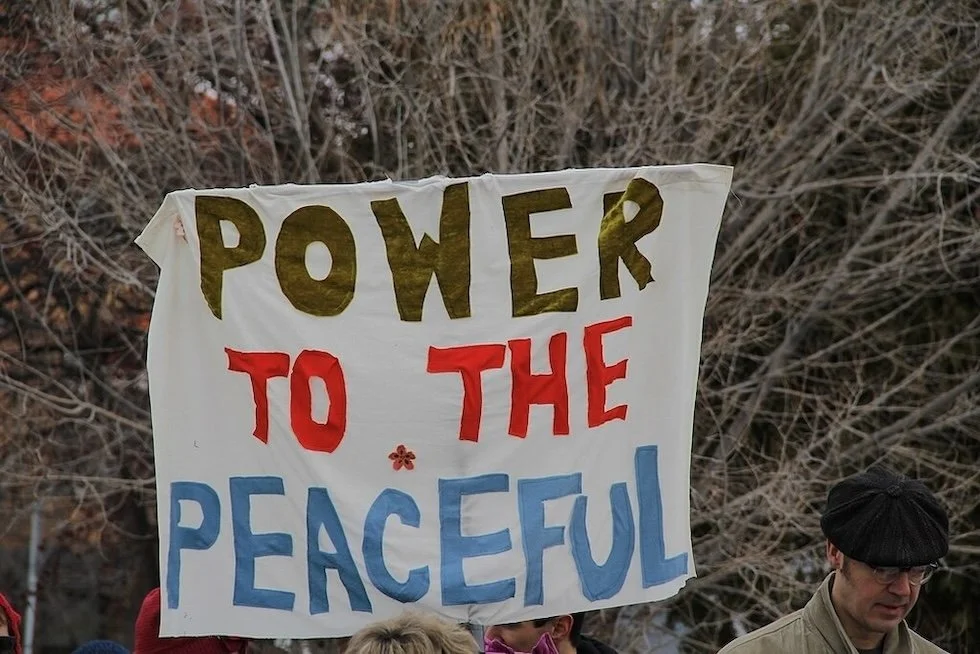
Sign from 2018 Women's March in Missoula, Montana. Montanasuffragettes, via Wikimedia Commons
Neither justice nor freedom can be pursued without a struggle for power. But the normative primacy of justice and freedom in the political domain places limits on this struggle. For power in the political domain must truly serve the ends of justice and contribute to liberation. When political power does not promote justice and freedom—when, for example, it becomes self-serving or downright oppressive—it becomes problematic and calls for resistance.
Indeed, the political exercise of power must itself be faithful to a fundamental principle that I describe as the expected justifiability of power: political power must either promise or prove to further justice and freedom. Exercises of political power that violate this expected justifiability cannot be legitimate, nor can they be appropriate to the ends of justice and freedom. As I indicated two years ago in a post about politics and religion, we can always evaluate current forms of political engagement in all three respects: justice, freedom, and power.
Hence, in principle, politics is not opposed to truth, and truth is not powerless in the political domain. Instead, politics is itself a social domain of truth. It is a domain where being faithful to the societal principle of justice and pursuing it on the basis of justifiable power can dynamically correlate with freeing the oppressed and thereby further the interconnected flourishing of all creatures. The justifiably empowered and liberating pursuit of justice characterizes the truth of politics. By virtue of this dynamic correlation, politics is a social domain of truth.
Post-Truth Politics
Now I’m no Pollyanna. By calling politics a social domain of truth, I don’t wish to ignore widespread falsehood within much of contemporary politics, falsehood both as organized lying and as injustice, oppression, and abuses of power. There’s no denying the prevalence of political untruth.
Yet I want to stress how intrinsic to politics the expectation of truth is. Because of this, truth in the sense of political truth is not essentially impotent and political power is not essentially untrue. Rather, in principle, political power can let truth unfold. It can let fidelity to justice correlate with liberation from oppression, provided such power is justifiable. That’s why political power which, in Arendt’s words, “gives no heed to truth” is indeed “despicable.” It’s despicable because such power is politically untrue: it resists the call to justice and cannot be justified.
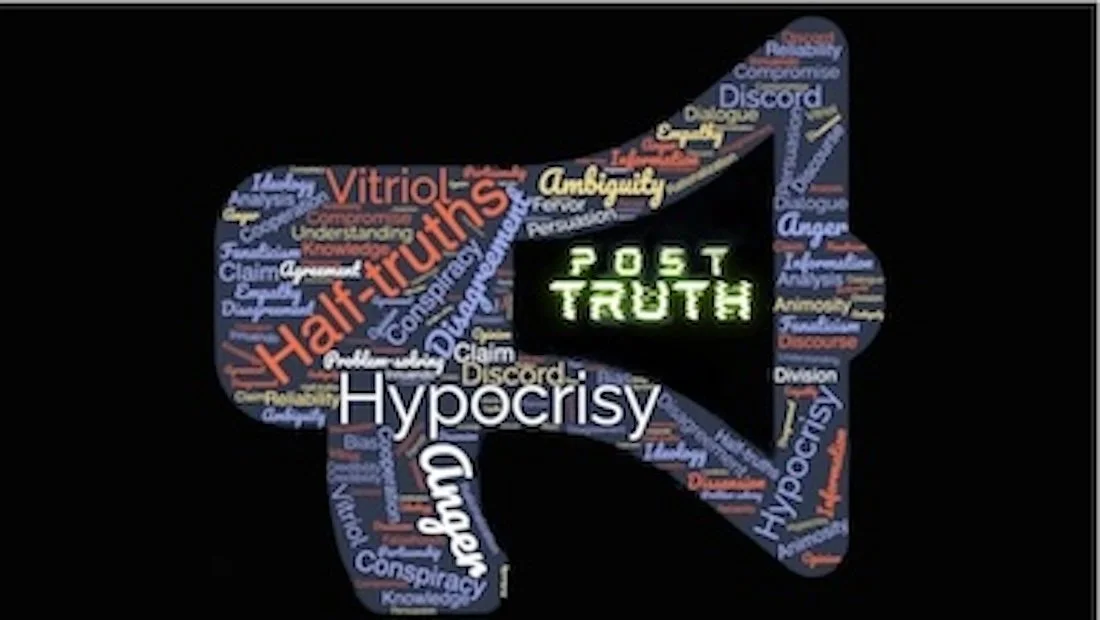
Photo illustration by News Decoder
But what about a politics that is completely deceitful in the way Arendt feared, which we now label post-truth politics? What about a politics in which supposed leaders, including the current President of the United States, habitually bullshit, lie, promote conspiracy theories, attack conscientious journalists, and deny scientific findings? Wasn’t Arendt right to call out the “mass manipulation of fact and opinion” and urge professional truthtellers to maintain their intellectual integrity “at any price”? Yes, emphatically, yes.
Still, I want to emphasize the political reason why everyone should despise post-truth politics and should expect intellectual integrity. The political reason is that political deceit undermines political truth, and intellectual integrity supports it. How can we address issues of justifiable power, achievable justice, and genuine liberation if we cannot rely on factually accurate findings and logically valid claims? How can we achieve such findings and claims if the people most responsible for developing them lack intellectual integrity? And how can professional propositional truthtellers help us address the most urgent political issues when supposed political leaders continually dismiss their work and belittle their integrity?
The massive deceitfulness of post-truth politics poisons the body politic. It kills the passion to achieve justice. And it blocks any commitment to justifiable power, including the rule of law. Post-truth politics is despicable because it is politically false. It must be resisted.
Note: I notify a list of readers when a new blog post is published. If you are not on that list and wish to join us, please let me know via the Contact button at the top of this page.