
Photo by Matt Paul Catalano on Unsplash.
Last week’s midterm elections in the United States had astonishing results. Few pundits expected the Democrats to achieve a monstrous majority in the House of Representatives. It was indeed a blue tsunami. At last count, the Democrats have 255 seats, to 166 for the Republicans. That’s nearly a 60 percent majority out of 435 total seats; it could go even higher when the remaining 14 undecided races are counted.
Still fewer thought the Democrats would not only decisively regain control of the Senate but also flip seven Republican seats in states Donald Trump won handily just two years ago. The latest numbers show the Democrats with 54 seats in the Senate and the Republicans with 44; two seats in heavily Republican Alaska and Mississippi are still undecided.
Letting the Old Politics Die

James Talarico. Image from the Talarico for Texas website.
I’ve read and heard many explanations for this surprising turnaround. The one that resonates most deeply comes from James Talarico, the newly elected Democratic Senator for Texas. After not electing a Democrat to the U.S. Senate for nearly 40 years, voters in Texas gave Talarico a rousing victory, 12 percentage points ahead of his Republican rival.
I’ve been following Talarico’s campaign since last January, when I posted James Talarico and the Politics of Love. In his victory speech on November 4, he proclaimed that the “old politics is dying and a new politics is being born.” We just showed, he said, that “a politics of division is no match for a politics of love.” His inspiring speech, which I urge you to watch or read, tells us what this means (here’s the link).
I like to think that, within and beyond all the worries that drove recent electoral choices—inflation, immigration, political corruption, economic hardships, congressionally unauthorized tariffs, unjustified warfare, etc.—a deeper motive prevailed. Perhaps, just perhaps, most voters are completely fed up with what Talarico calls “the deep spiritual corruption at the root of all these crises.” We’re bone-deep tired of the hatred and hostility that rich and powerful people stir up in order to distract us from their own agendas and line their own pockets. We long for a different way to sort out our political differences, for what Talarico calls a “politics of love.”
Looking Evil in the Eye
I realize, of course, that such a deeply spiritual motive is hard to capture in political opinion polls. It resists social-scientific quantification. Hardnosed political analysts and gimlet-eyed journalists might say our weariness and longing offer no real explanation for why Talarico and his fellow Democrats prevailed in such an astonishing way.
Yet I would urge them—and ask all of us—to pay attention to what Talarico actually says. He’s not telling fairy tales about sky-high happiness in the sweet by and by. Instead he calls citizens to the hard work of justice and liberation amid “the final howls of a dying establishment.”

Photo by Javier Esteban on Unsplash
Nor does Talarico ignore just how deep the patterns of injustice and oppression run. “There is something broken in America,” he says. “Our economic system is broken. Our political system is broken. Even our relationships with each other feel broken.” The love he advocates—love of God by loving our neighbors—is not passive, neutral, or weak. It requires us to stand up for those who suffer. It asks us to “look evil in the eye and not blink.”
The policies Talarico recommends flow from how he understands such love: removing big money from politics; addressing economic inequality; passing universal healthcare; fully funding public education; and ending America’s “corrupt forever wars.” We can question whether these issues are the right priorities or whether his policies are the best. But we should not underestimate just how powerful and persuasive is Talarico’s call to a politics of love.
Loving Our Enemies
What I find most impressive is how, in both demeanor and rhetoric, Talarico puts the love of enemy into political practice. In Jesus’s Sermon on the Mount, the barefoot rabbi, as Talarico calls him, urged his followers to love their enemies: “You have heard it was said, ‘You shall love your neighbor and hate your enemy.’ But I say to you, Love your enemies and pray for those who persecute you …” (Matthew 5.43-44, NRSV; cf. Luke 6.27-28 and Romans 12.20-21). I’ve often wondered how one can follow this injunction within the cut and thrust of everyday politics.
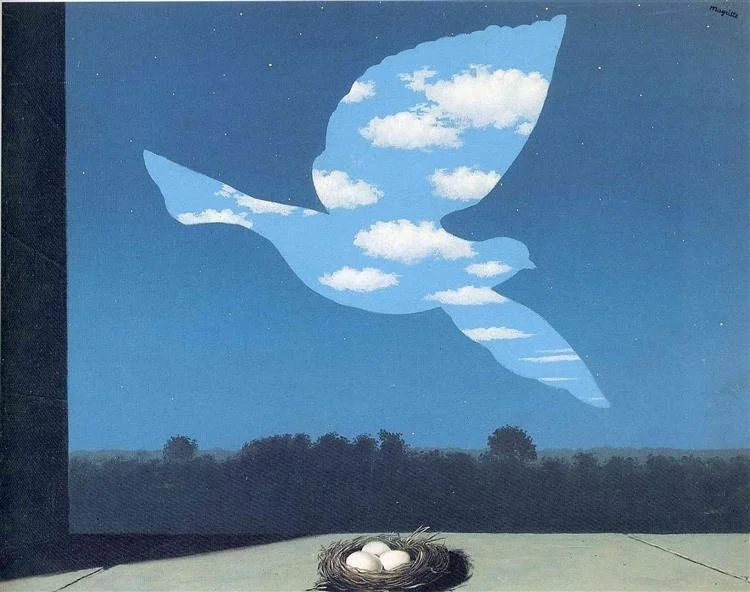
“Le retour” (The Return). Oil on canvas. René Magritte (1940). Image from WikiArt.
Talarico seems to have found a way. He doesn’t deny that there are enemies. Jesus didn’t deny this either. But he refuses to forget their status as image-bearers of God. No matter how hateful and hostile, political opponents, too, are our neighbors. We can reject the evil they do, but always out of care for the good they could be. To love them is to call them—and us—back to our deepest shared values. These include the societal principles of justice and solidarity. They help make up the sun that, according to Jesus, God shines on both the evil and the good (Matthew 5.45).
So the politics of love includes loving our political enemies. We should not confuse this with becoming civic wallflowers, however. To love our political enemies is to embrace what is potentially good, also in them, while staring evil in the eye—never forgetting that often, as Jesus said, the evil lies in us (Matthew 7.1-5).
That’s so hard to do, especially in the high-stakes hothouse of American politics. I still wonder what loving our political enemies really requires. Yet I’m grateful we’ve received an inspiring example in Talarico’s stunning victory last week.
Note: I notify a list of readers when a new blog post is published. If you want to join us, please let me know via the Contact button at the top of this page